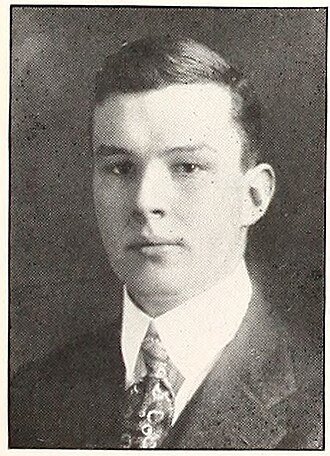
Haskell Curry
1900–1982 · American mathematician and logician, a central figure in combinatory logic
Haskell Brooks Curry (Millis, Massachusetts, 1900 - State College, Pennsylvania, 1982) was an American mathematician and logician. His work on the foundations of mathematics laid much of the theoretical groundwork for functional programming languages, although he always regarded logic as a discipline in its own right.
He studied at Harvard, where he began with medicine before turning to mathematics. His interest in logic was sparked by reading Whitehead and Russell's Principia Mathematica. After a period at MIT and a return to Harvard, he came across Moses Schönfinkel's work on combinatory logic at Princeton. He then moved to Göttingen, where he earned his doctorate in 1930 under David Hilbert and worked closely with Paul Bernays.
From 1929 he taught for decades at Pennsylvania State University. During the Second World War he did applied mathematics for the US government, and after the war he took part in the ENIAC project. In 1966 he became a professor of logic at the University of Amsterdam.
His aim was to show that combinatory logic could serve as a foundation for mathematics. The system does without variables and builds functions from a few basic operators. In 1933 John Rosser told him about the Kleene-Rosser paradox, which undermined formal systems related to his own. Curry did not abandon the approach; in 1942 he published the paradox that now bears his name. His philosophy of mathematics was formalist, following Hilbert, though he was also drawn to intuitionistic logic.
His legacy is twofold. Currying, the method of turning a function of several arguments into a chain of single-argument functions, is now a common idea in programming. The Curry-Howard correspondence links logical proofs with typed programs, and the programming languages Haskell and Curry bear his name.
Key ideas
- Combinatory logic: a system that builds functions from a few basic operators without using variables, offered as a possible foundation for mathematics.
- Formalism: mathematics as systems of symbols and rules that can be studied without appealing to prior meaning, in Hilbert's spirit.
- Paradoxes as guides: faced with contradictions, he did not drop the project but tried to understand and contain them.
- Currying: turning a function of several arguments into a chain of functions that each take one argument.
Curiosities
A programming language named after him
The programming languages Haskell and Curry are named after him, and currying, a technique that also carries his name, is a basic idea in functional programming.
An algorithm from the arsenal
During the Second World War, at the Frankford Arsenal, he developed a steepest descent algorithm based on work by Cauchy, which became a foundational example of modern gradient descent methods.
A paradox learned by letter
He learned of the Kleene-Rosser paradox near the end of 1933 through his correspondence with John Rosser.
Teachers and influences
Influenced by
- Alfred North Whitehead 1861–1947
Influenced
- Saul Kripke 1940–2022
Original Filopedia text based on Wikipedia (es) and Wikipedia (en) and Wikidata.