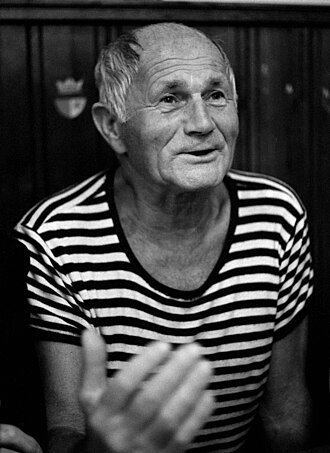
 AuthorBohumil Hrabal1914–1997
I Served the King of England is a novel by the Czech writer Bohumil Hrabal, published in 1971, although it was written during a period of censorship in the early 1970s and was not formally published in book form until 1983. Hrabal (1914–1997) is one of the most celebrated Czech authors of the postwar period, and this book is among his best-known works.
The novel follows Dítě, a short young waiter whose early work as a busboy awakens a growing fascination with money and what it seems to offer: admiration, impunity, women and elegance. His career takes him through hotels in different towns until he reaches one of the most luxurious establishments in Prague. He later builds his own hotel, which becomes the envy of hoteliers across the country, yet success does not bring him the social acceptance he hoped for. His humble origins, the way he acquired his fortune and his past as a collaborator with the Nazi occupation earn him resentment and enmity. After the communist takeover, his hotel is nationalised and he is sent to the so-called millionaires' prison, where inmates keep a comfortable lifestyle. He eventually withdraws to a remote mountain landscape, where he trades the pursuit of pleasure for quiet reflection and inner growth.
The historical background runs through the story: the German occupation, the resistance and the communist regime follow one another without the tone becoming bleak. Hrabal recounts the most tragic episodes with a light, irreverent touch that blends tenderness and surrealism, and the improbable is accepted with complete naturalness, so that the characters often seem like puppets in a larger farce. The protagonist recalls the rogue of the Spanish picaresque tradition and, at times, a figure somewhere between Sancho Panza and Don Quixote, caught between impossible dreams and the reality he gradually discovers. The novel has been compared with Jaroslav Hašek's The Good Soldier Švejk for its episodic structure and its protagonist's thwarted fate, and with Kafka, although critics caution against forcing such parallels.
The book was admired for its humanism, for the respect Hrabal shows his characters, and for the weight of the themes it raises about identity, ambition and guilt in twentieth-century Central Europe, all beneath a plain and sometimes humorous surface. In 2006 it was adapted to film by Jiří Menzel under the same title.
Themes
Other works by Bohumil Hrabal
Original Filopedia text based on Wikipedia (es) and Wikipedia (en) and Wikidata.