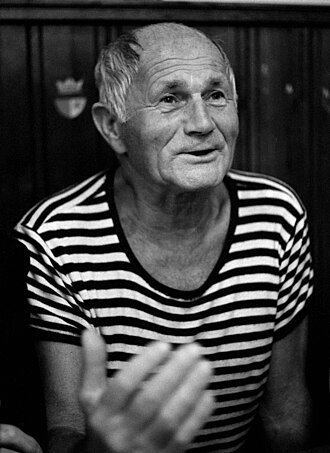
 AuthorBohumil Hrabal1914–1997
Too Loud a Solitude is a short novel by the Czech writer Bohumil Hrabal, first published in 1976. It circulated in samizdat, the clandestine press that evaded censorship in Czechoslovakia, and did not appear officially in the country until 1989, shortly before the Velvet Revolution. Hrabal had earned a law degree at Charles University in Prague in 1946 but never practiced law. He worked for years in a paper recycling plant, an experience that became the basis of the book. He had already written a first account of that job in the 1950s, and the subject returned in several versions of the novel, typed, photocopied and finally produced on a word processor.
The narrator is Haňťa, a reclusive man approaching retirement who has spent his life compacting wastepaper in a cellar in Prague. Besides cardboard and scraps, he compacts banned books slated for destruction. Before reducing them to bales, he reads and rescues them, and over the years he has accumulated more than two tons of volumes in his home, with a particular fondness for philosophy and religion. He works with deliberate slowness, wrapping each bale in reproductions of classic European paintings and placing a rare book at its heart. For him these bales are works of art, and he dreams of buying a hydraulic press on retiring, as his beloved uncle, a railwayman, did, and of holding an exhibition where visitors can learn to make their own.
The story moves between the present of his work, memories and everyday reflections. His uncle's death leads him to recall his first youthful love, a Gypsy girl he never saw again after she was seized during the Nazi occupation. When an automatic press operated by members of a Socialist Brigade of Labor arrives, Haňťa senses that his craft has come to an end. He is reassigned to pointless tasks, and in a dreamlike sequence he wanders the city, stops at several breweries and eventually returns to the cellar, where he places himself in the press holding a book by Novalis.
The novel has been read as an allegory of resistance to censorship and oppression, but its richness lies in its form. Hrabal practices what he called pábení, a meandering manner of storytelling that recalls the idle chatter of neighbours and the endless reminiscences of relatives. Its blend of everyday realism and reflection links it to the total realism cultivated by his friend Egon Bondy. Translated into English in 1990, it was well received by some critics, and its publication history, marked by censored and divergent editions, has become part of its meaning.
Themes
Other works by Bohumil Hrabal
Original Filopedia text based on Wikipedia (en) and Wikidata.