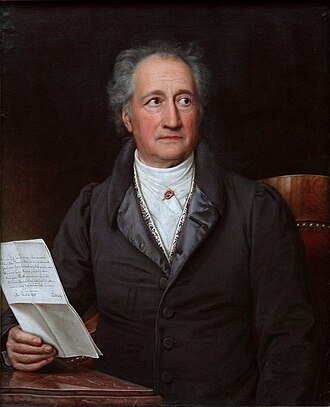
 AuthorJohann Wolfgang von Goethe1749–1832
Italian Journey is the account Johann Wolfgang von Goethe gave of his travels in Italy between 1786 and 1788. It was published in two parts, in 1816 and 1817. It is based on his diaries and on the letters he wrote during the trip to friends in Germany. Yet it is not a plain diary: Goethe smoothed the style, removed much of the spontaneity of his original notes, and added reflections and memories written decades later, so the book mixes the immediacy of what was lived with the view of a mature author.
In September 1786, just short of turning thirty-seven, Goethe slipped away from Weimar, in his own words. He was a privy councillor in the duchy, had a long platonic relationship with a lady of the court, and enjoyed enormous fame as the author of The Sorrows of Young Werther and the stormy play Götz von Berlichingen. He persuaded his employer, Duke Karl August, to grant him a paid leave of absence. He travelled through Innsbruck and the Brenner Pass, and visited Trento, Lake Garda, Verona, Vicenza, Padua, Venice, Bologna, Rome and the Alban Hills, Naples and Sicily. His aim was to see at first hand the country he had long imagined through books, and to find out whether what he had dreamed of really existed.
The book is shaped by the idea of Arcadia. Goethe opens with the Latin phrase "Et in Arcadia ego", which in his German version changes meaning: it is no longer Death who speaks, but a traveller who says that he too has reached paradise. That ambiguity runs through the whole book, in which nostalgia coexists with the awareness that paradise, if it exists, can be lost. It closes with a quotation from Ovid's Tristia about exile from Rome.
Goethe's attention turns above all to classical antiquity and the Renaissance, much less to the Baroque that then dominated much of Italy. He speaks of medieval art with scorn, and his decision not to visit Giotto's frescoes in Assisi has been widely questioned. In Verona he is delighted by the amphitheatre, which he regards as the first truly classical work he saw. In Venice he studied the books of Andrea Palladio intensively, and that architecture became his standard for thinking about beauty and good building.
In Rome, where he stayed for most of his time, he lived with the painter Johann Heinrich Wilhelm Tischbein in a house that is now a museum. He mixed with German and Swiss artists, with Angelica Kauffman and with Karl Philipp Moritz. There he drew and painted, and for a short while considered becoming a painter, though he soon recognised his limits. He also returned to his dramatic work, such as Iphigenia, and thought about his collected works. He travelled to Naples, Pompeii and Herculaneum, and visited the Greek temples at Paestum several times. In Sicily he was drawn to the Greek ruins at Agrigento and searched for the so-called Urpflanze, an archetype of all plants.
The book also reveals a notable scientific interest. Goethe collected mineral and rock samples, described the lava flows of Vesuvius, which he climbed several times, and observed plants with the eye of a naturalist. This blend of science and art is part of the transformation the journey worked in him.
Italian Journey was widely read and has become one of the most influential texts on the experience of travelling to Italy in German literature. Its mixture of diary, essay and self-portrait has shaped how the formative journey is understood, and it helped foster a Romantic view of antiquity.
Themes
Other works by Johann Wolfgang von Goethe
- The Sorrows of Young Werther 1774
- Prometheus 1785
- Egmont 1788
- Wilhelm Meister's Apprenticeship 1790
- The Sorcerer's Apprentice 1797
- Faust 1808
- Elective Affinities 1809
- Theory of Colours 1810
- West–Eastern Diwan 1819
Original Filopedia text based on Wikipedia (en) and Wikidata.