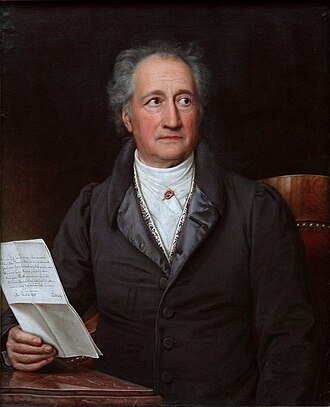
 AuthorJohann Wolfgang von Goethe1749–1832
"The Sorcerer's Apprentice" (in German, "Der Zauberlehrling") is a narrative poem by Johann Wolfgang von Goethe, published in 1797. It takes the form of a ballad in fourteen stanzas and belongs to the body of work in which the German author drew on popular material from oral tradition and legend.
The plot is simple and highly visual. An old sorcerer leaves his workshop and entrusts his apprentice with household chores. Tired of carrying water in a pail, the young man enchants a broom so that it does the work for him. But he has not fully mastered the art of magic, and when the floor begins to flood he discovers that he does not know how to stop the spell. In desperation he splits the broom in two with an axe, but each half becomes a whole broom that keeps fetching water, now at twice the speed. When all seems lost, the old master returns, undoes the enchantment and remarks that only a true master should summon powerful spirits.
The poem belongs to a widely spread narrative tradition. Folklorists have linked its motif to the Aarne–Thompson–Uther type ATU 325, which groups tales about a magician and his pupil, and have pointed to older precedents, such as an episode in the Tale of Setne Khamwas and Si-Osire or the story of Pancrates recorded by Lucian in his Philopseudes, written around 150 AD. In other versions the sorcerer grows angry and even dismisses the apprentice, whereas in Goethe's text the rebuke is calmer and focuses on the need to master what one summons.
The poem is very well known in the German-speaking world. Its line "Die Geister, die ich rief" ("The spirits that I summoned") has become a common expression for someone who calls on help or allies that he then cannot control, especially in politics. The work later reached an even wider audience through Paul Dukas's symphonic piece of 1897 and, above all, through its segment in Disney's film Fantasia (1940).
Themes
Other works by Johann Wolfgang von Goethe
- The Sorrows of Young Werther 1774
- Prometheus 1785
- Egmont 1788
- Wilhelm Meister's Apprenticeship 1790
- Faust 1808
- Elective Affinities 1809
- Theory of Colours 1810
- Italian Journey 1816
- West–Eastern Diwan 1819
Original Filopedia text based on Wikipedia (es) and Wikipedia (en) and Wikidata.