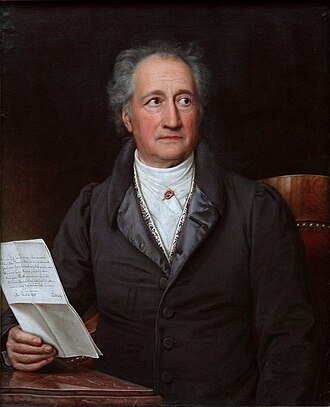
 AuthorJohann Wolfgang von Goethe1749–1832
The West–Eastern Diwan is the last major poetry collection by Johann Wolfgang von Goethe. It was first published in 1819 and was expanded in a version issued in 1827. It consists of twelve books, each with a German title and an Oriental title, and gathers poems of many kinds: lyrics, parables, historical allusions, invective, and pieces of political or religious inclination.
Goethe wrote it between 1814 and 1819, inspired by the German translation of the Persian poet Hafez made by the Austrian orientalist Joseph von Hammer-Purgstall, which reached him in 1814. Many of the verses also grew out of his correspondence with Marianne von Willemer, who composed some of them; Goethe revised these before including them in the Suleika book.
The collection is read as an exchange between East and West, not only between Germany and the Middle East but also between Latin and Persian cultures and between Christian and Muslim traditions. Goethe added explanatory notes on historical figures, events and places. The work influenced poets such as Friedrich Rückert and Walter Benjamin, inspired settings by composers including Schubert, Schumann and Mendelssohn, and in 1923 the Persian-language Indian poet Muhammad Iqbal answered it with his Payam-e-Mashriq.
Themes
Other works by Johann Wolfgang von Goethe
- The Sorrows of Young Werther 1774
- Prometheus 1785
- Egmont 1788
- Wilhelm Meister's Apprenticeship 1790
- The Sorcerer's Apprentice 1797
- Faust 1808
- Elective Affinities 1809
- Theory of Colours 1810
- Italian Journey 1816
Original Filopedia text based on Wikipedia (es) and Wikipedia (en) and Wikidata.