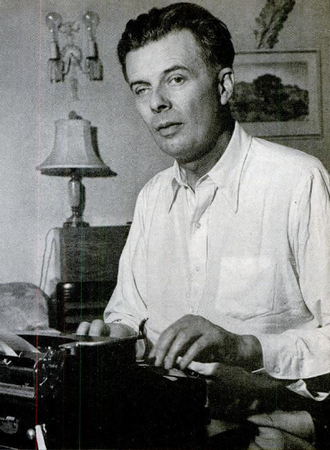
 AuthorAldous Huxley1894–1963
Brave New World is a dystopian novel by the English writer Aldous Huxley, written in 1931 at Sanary-sur-Mer in the south of France and published in 1932. It was his fifth novel and his first dystopian work. Huxley had already made a name for himself as a satirist with novels such as Crome Yellow and Point Counter Point, and in this book he gave shape to a long-standing unease: the fear of a humanity that, in the name of stability and happiness, gives up nearly everything that makes human life valuable.
The story is set in the year 632 After Ford (AD 2540), in a World State where people are not born but manufactured in hatcheries. Each individual is assigned in advance to a caste, marked by Greek letters, ranging from the Alphas, destined to lead, to the Epsilons, condemned to the most monotonous work and given limited intellect. Children are conditioned during sleep through hypnopaedia, which instils the virtues of their place in the social order from infancy. To this is added soma, a drug that produces contentment and dispels discomfort, and a cult of Henry Ford, whose name replaces God in the calendar and whose Model T has become a quasi-religious symbol. Science, art, the family and love have been banished in favour of a stability that no one questions.
The novel follows chiefly Bernard Marx, a short Alpha psychologist who distrusts the system, and Lenina Crowne, a hatchery worker who obeys the norm of casual promiscuity without remorse. Together they travel to a Savage Reservation in New Mexico, where they meet Linda, a former inhabitant of the World State who lives there with her son John, born of a relationship with a senior official of the very system. John, who has been educated through the reading of Shakespeare, is later brought into civilisation, where he becomes a curiosity and a critical observer of his world. His clash with Mustapha Mond, one of the World Controllers, forms the philosophical core of the book: Mond argues that stable happiness requires the sacrifice of truth, art and freedom, while John maintains that without pain and anguish, joy has no meaning.
The work was inspired by the optimistic utopias of H. G. Wells, which Huxley wanted to answer with a negative vision, and its title comes from a line in Shakespeare's The Tempest. Since its publication it has been one of the most widely read and debated novels of the twentieth century, and it is regarded, alongside George Orwell's Nineteen Eighty-Four, as a central reference of dystopian fiction. Huxley revisited it in 1958 in the essay Brave New World Revisited, reconsidering several of his predictions in the light of consumer society and mass manipulation.
Themes
Other works by Aldous Huxley
- Crome Yellow 1921
- Antic Hay 1923
- Those Barren Leaves 1925
- Eyeless in Gaza 1936
- After Many a Summer 1939
- The Perennial Philosophy 1944
- Ape and Essence 1948
- The Doors of Perception 1954
- Heaven and Hell 1956
- Brave New World Revisited 1958
- Island 1962
Original Filopedia text based on Wikipedia (es) and Wikipedia (en) and Wikidata.