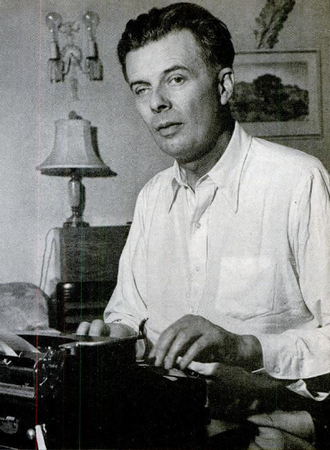
 AuthorAldous Huxley1894–1963
The Doors of Perception is an autobiographical essay that Aldous Huxley published in 1954, describing his experience with mescaline, the psychoactive compound of the peyote cactus. The essay grew out of a specific event: in May 1953, Huxley took the drug at his home in West Hollywood under the supervision of Humphry Osmond, a British psychiatrist who was studying its possible therapeutic uses. Huxley had written to Osmond offering himself as a subject, and he had long been interested in spirituality, meditation and the perennial philosophy.
The title comes from a passage by William Blake, who in The Marriage of Heaven and Hell imagined doors of perception that, if cleansed, would reveal things as they truly are, infinite. Huxley takes up the metaphor to argue that the brain works as a reducing valve, filtering the overwhelming flow of stimuli into something manageable, and that certain substances may loosen that filter. During the experience he describes ordinary objects taking on an intense, almost sacred presence, space and time losing their grip, and perception becoming at times overwhelming and even disturbing.
The text distinguishes between a purely aesthetic vision, rich in sensory detail, and what he calls a sacramental vision, in which reality seems to disclose a deeper meaning. Huxley reflects on these states with caution, acknowledging that they are subjective and should not be simply equated with religious mysticism. The book was published alongside Heaven and Hell (1956), a companion essay that develops these reflections further, and the two have often been issued together.
The work provoked strong and divided reactions. Some readers took it as a case for psychedelics as a route to insight and a possible aid to science, art and religion. Others, including the German writer Thomas Mann, the Jewish philosopher Martin Buber and the Orientalist Robert Charles Zaehner, argued that mescaline's effects are subjective and should not be confused with genuine religious mysticism. Huxley continued to take psychedelics for the rest of his life, and what he believed he learned from them shaped his final novel, Island (1962).
Themes
Other works by Aldous Huxley
- Crome Yellow 1921
- Antic Hay 1923
- Those Barren Leaves 1925
- Brave New World 1932
- Eyeless in Gaza 1936
- After Many a Summer 1939
- The Perennial Philosophy 1944
- Ape and Essence 1948
- Heaven and Hell 1956
- Brave New World Revisited 1958
- Island 1962
Original Filopedia text based on Wikipedia (es) and Wikipedia (en) and Wikidata.