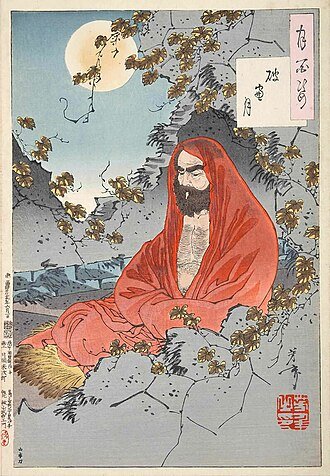
 AuthorBodhidharma440–540
The Treatise on the Two Entrances and Four Practices (in Chinese, Erru Sixing) is a Buddhist text attributed to Bodhidharma, traditionally regarded as the founder of Chan Buddhism, known in Japan as Zen. Its title refers to two ways of reaching awakening: the entrance of principle, which means seeing through the obscurations of everyday mind and revealing one's true nature, that is, Buddha nature, and the entrance of practice, which means cultivating a detached attitude toward the changing circumstances of life through daily disciplines.
The section on practice lists four disciplines: accepting all suffering as the fruit of past wrongs without resentment or complaint; remaining unmoved even by good fortune, recognizing its impermanence; being free of craving, the root of all suffering; and acting in accordance with the Dharma, dispelling mistaken thoughts and practicing the six perfections.
The text circulated in the sixth century among wandering monks of northern China devoted to meditation, who regarded Bodhidharma as their spiritual forebear. Probably around the eighth century, a considerable amount of anonymous material was added to it. Its two-part structure, with one abstract and one concrete path, was frequently copied and became typical of early Chan. In 1935, Daisetsu Teitaro Suzuki included it, together with other manuscripts, in a larger compilation known as the Long Scroll, whose parts had been found at Dunhuang.
Themes
Original Filopedia text based on Wikipedia (en) and Wikidata.