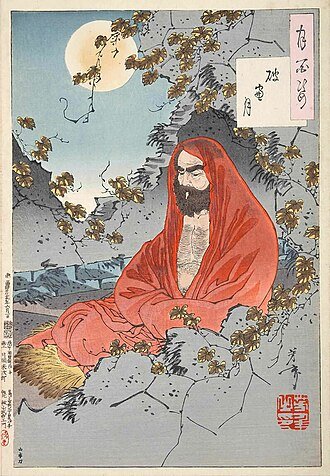
Bodhidharma
440–540 · Indian Buddhist monk and semi-legendary patriarch of Chan
Bodhidharma was an Indian-born Buddhist monk whom tradition regards as the twenty-eighth patriarch of Buddhism and the first patriarch of Chan in China, the school that later gave rise to Japanese Zen. He is usually placed between the late fifth and early sixth centuries, yet almost no contemporary documents about him survive, and most of what is told about him is mixed with legend. He matters because a foundational story of a form of Buddhism centred on direct meditation grew up around his figure.
The oldest accounts describe a man who came from the Western Regions, a term that could mean Central Asia or the Indian subcontinent. Some texts present him as a South Indian, others as a Central Asian. According to tradition, he travelled by sea to southern China and then moved northwards, crossing the Yangtze River, until he reached the territory of the Northern Wei. The sources disagree on the date of his arrival, placing it under the Liu Song in one case and under the Liang in another, so the chronology remains uncertain.
His reputation became legendary largely because of his long meditation. Later stories say he spent many years seated before a cave wall near the Shaolin Monastery, in near-total silence. He is also associated with the practice of wall-gazing, whose precise meaning is still debated among scholars. A tradition made popular in the twentieth century presents him as the founder of Shaolin kung fu, but historians regard that idea as late and weakly supported.
The teaching attributed to him appears mainly in the short treatise Two Entrances and Four Practices, whose authorship is also uncertain. The text describes two ways into the Dharma. The first is an entrance through principle, a sudden grasp of the ultimate nature of reality. The second is an entrance through practice, made of four attitudes: accepting suffering as the fruit of past karma, meeting circumstances with equanimity, being free of craving, and abandoning mistaken thoughts while cultivating the six perfections.
His influence was considerable. Chan spread through China and later into Korea, Vietnam and Japan, where it became Zen. The image of the bearded monk with large eyes became a recognisable motif in Buddhist art, and his name gave rise to the daruma dolls, now known around the world.
Key ideas
- Entrance through principle: a sudden grasp of the ultimate nature of reality, without conceptual detours.
- Entrance through practice: a path that transforms one's attitude to life through everyday action.
- Four practices: accepting suffering as the fruit of karma, keeping equanimity, being free of craving, and abandoning mistaken thoughts.
- Wall-gazing: a seated meditation of mental stillness whose exact meaning is still debated.
Works in Filopedia
Curiosities
A borrowed reed boat
According to the story, when he reached the Yangtze no boat was available, because the locals had sent them all away. An old woman lent him a reed boat, and he crossed the river standing on it.
Nine years facing a wall
Later accounts say he sat for nine years before a wall in a cave at Shaolin. Tradition holds that his shadow was left imprinted on the stone.
The single sandal
It is said that, years after his death, an official met him in Central Asia carrying a single sandal. When his tomb was opened, only the other sandal was found inside.
Original Filopedia text based on Wikipedia (es) and Wikipedia (en) and Wikidata.