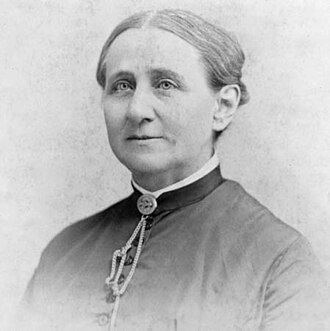
 AuthorAntoinette Brown Blackwell1825–1921
The Sexes Throughout Nature is a book by Antoinette Brown Blackwell, published in 1875 by G. P. Putnam's Sons. It appeared four years after Charles Darwin's The Descent of Man (1871), and the author conceived it as a systematic response to Darwin and to Herbert Spencer, whom she regarded as the most influential thinkers of her day. Blackwell had corresponded with Darwin, who in 1869 thanked her for a copy of her book Studies in General Science. Parts of the material had first appeared in periodicals such as the Woman's Journal and the Popular Science Monthly.
The author accepts the basic principles of natural selection and evolution, but argues that a male-dominated scientific community had misread the evidence about female physiology and behaviour. Her central thesis is the so-called "Theory of Equivalence": the sexes are "equivalents, equals but not identicals." For Blackwell, every trait developed in the male has a corresponding and equivalent expenditure of energy in the female, particularly in the demanding functions of reproduction and gestation. Against the view that size, strength or combativeness signal superiority, she proposes that biological complexity should be the measure. To make the point she draws on the lion, arguing that the female's reproductive system represents a higher degree of complexity than the male's mane or muscle mass.
Blackwell also stressed cooperation rather than rivalry as a driver of evolution, and she is regarded as one of the first to identify what is now called androcentrism in scientific method. Contemporary reviews were mixed: some praised it as a contribution to the debate over sex and education, while others dismissed it. The book was reissued by Hyperion Press in 1976, 1985 and 1992, and is considered an early precursor of feminist critiques of evolutionary biology.
Themes
Original Filopedia text based on Wikipedia (en) and Wikidata.