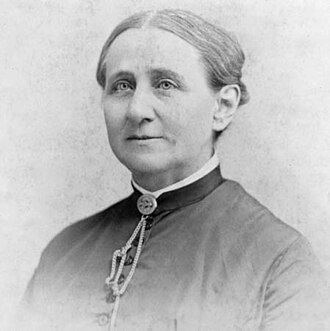
Antoinette Brown Blackwell
1825–1921 · writer, activist and the first woman ordained as a Protestant minister in the United States
Antoinette Louisa Brown, who later wrote under the name Antoinette Brown Blackwell (Henrietta, New York, 1825 - 1921), was an American writer and reformer best known for becoming the first woman ordained as a minister of a mainstream Protestant church in the United States. She belongs to the early years of the women's rights movement, and what set her apart from many of her peers was her decision to argue for women's rights from within religious faith.
She was the youngest of seven children in a family that supported her education. Connected to the Congregational Church, she studied at Oberlin College in Ohio, where she attended theology courses without being granted a degree. She soon became known as a speaker on abolition, temperance and women's rights. She took part in the first National Women's Rights Convention in 1850 and was ordained in 1852. She married Samuel Blackwell in 1856, and within a few years family duties and disagreements with parts of the feminist movement led her to leave public speaking and turn to writing.
Her thinking combined a commitment to equality with several qualified positions. She supported women's suffrage but believed the vote would achieve little without real access to power. She opposed divorce and held that women could work outside the home without neglecting their family responsibilities. Her best-known book, The Sexes Throughout Nature (1875), answers Charles Darwin's The Descent of Man (1871). Blackwell argued that Darwin had looked at nature through a male perspective and that women should study women. She carefully reanalysed data published by Darwin himself and concluded that the sexes, different by nature, are equal partners in evolution.
Today she is remembered above all as a pioneering feminist critic of Darwin and as a social philosopher. She was admitted to the American Association for the Advancement of Science and, in 1993, was inducted into the National Women's Hall of Fame.
Key ideas
- Faith as a lever for change: she held that women's active participation in religion could improve their standing in society.
- Suffrage is not enough: the vote had little effect without real opportunities for leadership and representation.
- Equality in difference: the sexes differ by nature but are equivalent within biological evolution.
- Science studied from women's perspective: the study of women should be carried out from their own standpoint, not only from a male one.
Works in Filopedia
Curiosities
A letter from Darwin
Darwin replied kindly to her first book, but his letter opened with 'Dear Sir', as he did not imagine that his correspondent, who signed as A. B. Blackwell, was a woman.
Voting at 95
In 1920, at the age of 95, she cast her vote in a presidential election for the first time. She was the only participant in the 1850 convention who lived long enough to exercise the suffrage.
Original Filopedia text based on Wikipedia (es) and Wikipedia (en) and Wikidata.