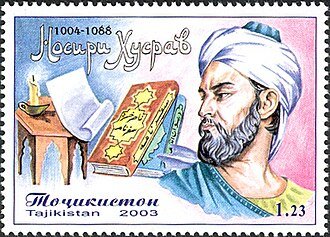
 AuthorNasir Khusraw1004–1088
The Safarnama, whose title means something like "book of travels," is an autobiographical account by the Persian philosopher and poet Nasir Khusraw (1003–1077) of a journey of about seven years through the main cities of the eleventh-century Islamic world. It is one of the earliest significant prose works written in New Persian, and it had a lasting influence on later Persian literature.
Little is known about Nasir Khusraw's life before the journey. He received a solid education, as his command of the sciences of his time shows throughout the narrative, and he became a state official in Merv, in Khorasan, first under the Ghaznavids and later under the Seljuks. Around 1045 he resolved to make the pilgrimage to Mecca. He himself describes this decision as arising from a dream in which a voice urged him toward spiritual purification and pointed toward the qibla. He then gave up his possessions and his post. He set out in March 1046, amid economic hardship and political instability in Khorasan, after the Seljuk advance had brought down Merv, Nishapur and Balkh.
His route was far from direct. From Nishapur he did not join the caravan bound for the Hijaz but travelled instead toward Ray, Qazvin, Tabriz and Diyarbakır, and on into Syria. There he records his encounter with Abu al-Ala al-Ma'arri, the blind poet and ascetic, and passes through Aleppo, Tripoli, Beirut, Acre and Haifa before reaching Jerusalem. He then went on to Egypt, the heart of Fatimid power, where he marvelled at the country's wealth, its multi-storey houses, its markets and its mosques. After performing the pilgrimage to Mecca and visiting Medina, he spent a year near the caliph al-Mustansir, a period in which his conversion to Ismaili teaching is presumed to have taken place. He returned to Khorasan in 1052, seven years after his departure.
The work is valued for the precision of its descriptions of cities, civic buildings and markets, particularly of Jerusalem, Mecca, Medina and Cairo. Its prose is plain and reads more like a travel journal than his poetry and philosophy. On his return, Nasir Khusraw devoted himself to spreading Ismailism as a missionary, which cost him the favour of the Sunni Seljuk rulers and led to his exile to the region of Yamgan in the Pamir mountains, where he spent his final years writing his principal treatises.
Themes
Other works by Nasir Khusraw
Original Filopedia text based on Wikipedia (es) and Wikipedia (en) and Wikidata.