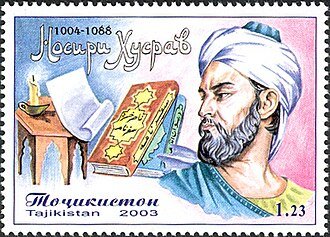
Nasir Khusraw
1004–1088 · Persian Ismaili poet, traveler and philosopher
Nasir Khusraw (1004 – between 1072 and 1088) was a Persian-speaking poet, traveler, theologian and philosopher of the Ismaili tradition, and one of the great names of classical Persian literature. He lived in eastern Khorasan, in what is now Afghanistan, at a time when Turkic and Persian dynasties competed for power. His importance lies both in his ideas and in his defense of Persian as a language for philosophy, which was unusual in a world where Arabic dominated.
He was born in Qubadiyan, near Balkh, into a well-off family of officials and landowners. He worked as a scribe and administrator at the Ghaznavid court and later under the Seljuks in Merv. Around the age of forty he went through a spiritual crisis which, by his own account, had the character of a dream. He left his post and converted to Ismailism. In 1045 he set out on a journey that lasted nearly seven years. He made the pilgrimage to Mecca, passed through Iran, Armenia and Asia Minor, and reached Cairo, where he met the Fatimid court and his teacher al-Mu'ayyad fi'l-Din al-Shirazi.
When he returned to Khorasan in 1052 to carry out his mission, he met strong hostility from Sunni opponents and was forced to flee. Around 1060 he found refuge in Yamgan, in the mountains of Badakhshan, where he spent his last decades with a circle of followers and wrote most of his work.
His best-known book is the Safarnama, a travel account describing in detail cities, madrasas, caravanserais, mosques, rulers and customs. His Diwan gathers poems about nature and the celestial spheres, lament over folly, reflections on the vanity of the world, and defense of Ismaili doctrine. In prose he wrote the Jami al-hikmatayn, which tries to reconcile Greek philosophy with religion, along with treatises such as the Gushayesh va rahayesh.
In his thought, revelation (tanzil) presents truths in a form people can grasp, while esoteric interpretation (ta'wil) restores their original intellectual meaning. For this reason he stressed the need to seek out someone able to explain that meaning. He is regarded as a founding figure of Ismailism in Central Asia and is revered as pir by communities in Badakhshan. His legacy endures in Persian literature and in the memory of those communities.
Key ideas
- Harmony between philosophy and religion: he sought to show that Greek wisdom and Islamic revelation could be understood together.
- Revelation and interpretation: tanzil conveys truths in an understandable form, and ta'wil returns them to their original intellectual meaning.
- The need for a guide: the outward form of religion is not enough; one must seek someone who can explain its inner meaning.
- Persian as a language of thought: he argued that philosophy and science could be expressed in his native tongue.
- The vanity of the world: his poems and treatises warn against ambition, luxury and the hypocrisy of courts.
Where to start
Start with the Safarnama because it is an accessible autobiographical account in which Naser Khusraw recounts a journey of about seven years through the main cities of the eleventh-century Islamic world. The reader will find a personal view of places, people and scholars of the period, together with the author's religious and philosophical concerns.
Next: Diwan. After the travel account, the Diwan lets the reader approach his poetic voice, with poems largely composed in the remote valley of Yumgan.
Works in Filopedia
Curiosities
A dream that changed his life
According to his own account, the spiritual crisis that led him to leave his post had the character of a dream.
A fake autobiography
For centuries a fake autobiography bearing his name has circulated among Ismailis and non-Ismailis alike.
Original Filopedia text based on Wikipedia (es) and Wikipedia (en) and Wikidata.