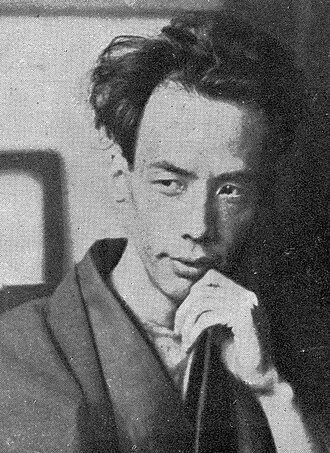
 AuthorRyūnosuke Akutagawa1892–1927
Rashōmon is a short story by the Japanese writer Ryūnosuke Akutagawa, based on tales from the Konjaku Monogatarishū. It was first published in 1915, when the author was twenty-three, in the magazine Teikoku Bungaku (Imperial Literature), founded by students of the Imperial University of Tokyo. Its title refers to the Rashōmon gate, the larger of the two gates of the city of Kyoto during the Heian period, a name taken from a Noh play of around 1420 also called Rashōmon, although the plot has no connection with that work.
The story unfolds in a ruined Kyoto, whose southern gate was sometimes used as a place to abandon unclaimed corpses. A servant recently dismissed, with no work and no shelter, weighs whether to starve or to become a thief in order to survive. Climbing to the upper floor of the gate, where he sees firelight, he finds an old woman pulling hair from the corpses. Disgusted, the man resolves to choose righteousness even at the cost of starvation, but the woman justifies herself: she takes the hair to make wigs so she can live, and the dead woman had sold snake meat as if it were fish. The tale ends by leaving open the moral ambiguity of stealing to survive, posed with a bluntness that makes it a reflection on necessity and ethics.
The work had considerable impact and became a staple of Japanese school reading. Akira Kurosawa took its title and drew some elements from it for his 1950 film, although that film's central plot comes from another Akutagawa story, In a Grove. The tale has since lent its name to a common expression in critical discourse and inspired numerous adaptations in film, music and manga.
Themes
Other works by Ryūnosuke Akutagawa
- The Nose 1916
- The Spider's Thread 1918
- Hell Screen 1918
- In a Grove 1922
- Spinning Gears 1927
Original Filopedia text based on Wikipedia (es) and Wikipedia (en) and Wikidata.