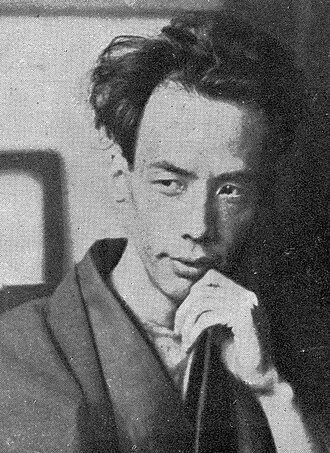
 AuthorRyūnosuke Akutagawa1892–1927
Hell Screen is a short story by the Japanese writer Ryūnosuke Akutagawa, first published in 1918 as a serial in two newspapers. It reworks a tale from the medieval collection Uji Shūi Monogatari and reflects one of Akutagawa's recurring methods: retelling ancient stories through the lens of modern psychology. It was later included in the collection Akutagawa Ryūnosuke zenshū.
The story is narrated by a servant of the Lord of Horikawa, who witnesses some events and hears of others. Its central figure is Yoshihide, regarded as the greatest painter in the land, who is often commissioned by the lord. Yoshihide's daughter works in the lord's mansion, and rumour has it that he intends to make her his mistress. When Yoshihide is asked to paint a folding screen depicting the Buddhist hell, he tortures his apprentices so that he can see what he is trying to depict, and at times he seems possessed by supernatural forces. He tries to win back his daughter, but is refused. The climax comes when Yoshihide asks the lord to burn a beautiful woman inside a carriage so that he can finish the screen, claiming he can only paint what he has seen. The lord agrees, and the painter is forced to watch as his own daughter is the one who burns. The story closes with the finished screen and Yoshihide's suicide by hanging.
Critics have often focused on its portrayal of artistic obsession, in which the artist places his art above his life, and on its meditation on the objectivity of truth, embodied in a narrator who stubbornly refuses to see what is plainly before him. The work has inspired many adaptations, among them a kabuki version by Yukio Mishima in 1953, a 1969 film by Toho, and a 1994 ballet by the Ukrainian composer Victoria Poleva.
Themes
Other works by Ryūnosuke Akutagawa
- Rashōmon 1915
- The Nose 1916
- The Spider's Thread 1918
- In a Grove 1922
- Spinning Gears 1927
Original Filopedia text based on Wikipedia (en) and Wikidata.