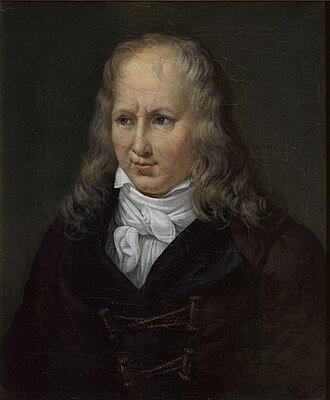
 AuthorJacques-Henri Bernardin de Saint-Pierre1737–1814
Paul et Virginie is a novel by Jacques-Henri Bernardin de Saint-Pierre, published in 1787 and generally regarded as his finest work. It was written on the eve of the French Revolution and is set on the island of Mauritius under French colonial rule, then called the Île de France, a place the author had come to know first-hand. Part of the plot draws on a shipwreck he witnessed there, that of the Saint-Géran in 1744.
The story is framed as a recollection: a young visitor at Port-Louis hears an old man speak of two families who once lived in small huts apart from the town, models of virtue. He then tells the tale of Paul and Virginie, raised almost as siblings by two single mothers, Marguerite and Madame de La Tour, amid tropical landscapes and cut off from the wider world. Their life is one of simplicity, mutual help and labour with their own hands, relying only on what nature provides. A decisive episode occurs when the two children, still young, encounter a beaten slave and accompany her back to her master to plead for mercy, an act that reveals their moral sensitivity. As adolescence arrives, an innocent love grows between them, but their mothers judge the match premature. Virginie's great-aunt, wishing her to inherit property in France, insists on sending her away. Virginie obeys with a heavy heart, and during her absence Paul learns to read and write so that he can correspond with her. Her return ends in tragedy: the ship bringing her home is wrecked near the shore, and Virginie drowns, refusing to undress to save herself out of modesty. Paul soon succumbs to grief, and shortly afterwards Marguerite and Madame de La Tour die as well.
The novel criticises the class divisions of French society and presents an Enlightenment ideal close to that of Rousseau: harmonious coexistence, shared possessions, and a Providence that has designed the world for human happiness. Bernardin, a friend of the governor Mahé de La Bourdonnais, also supports the abolition of slavery, although his protagonists own slaves whom they treat humanely. The book enjoyed great success, inspired a parody by Villiers de L'Isle-Adam, a celebrated opera by Jean-François Le Sueur, and is mentioned by writers such as Balzac, Flaubert and Dickens.
Themes
Original Filopedia text based on Wikipedia (es) and Wikipedia (en) and Wikidata.