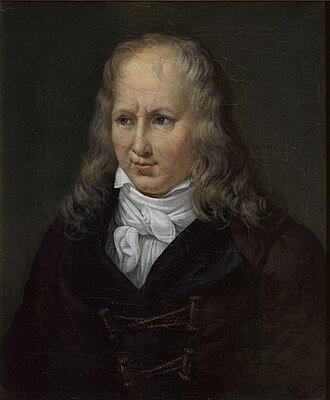
Jacques-Henri Bernardin de Saint-Pierre
1737–1814 · French writer and botanist
Jacques-Henri Bernardin de Saint-Pierre (born in Le Havre in 1737, died in Éragny in 1814) was a French writer and botanist who lived between the Enlightenment and the early Romantic period. He wrote in French and is remembered above all for the novel Paul et Virginie, one of the most widely read books of its age. It shows how Enlightenment sensibility began to look at nature with feeling as well as with scientific curiosity.
His early life mixed adventure with technical training. After a voyage to the West Indies with an uncle who was a sea captain, he trained as an engineer and joined the army, where he took part in campaigns of the Seven Years' War until he was dismissed for insubordination. He then travelled through Russia, Poland, Germany, the Netherlands and Malta in search of work. In 1768 he sailed to Mauritius as the king's engineer. Back in Paris in 1771, he became a friend and disciple of Jean-Jacques Rousseau, whose influence shaped both his prose and his habit of studying plants closely.
His Voyage to the Île de France (1773) earned him a reputation, though not a large readership. The Studies of Nature (1784) brought him fame and money. In it he tried to prove God's existence through the wonders of the natural world, setting a philosophy of feeling against the materialism of the Encyclopaedists. His recurring themes are nature, simple virtue and morality, and the contrast between corrupt city life and the harmony of distant landscapes. His style is sentimental and vivid, with occasional touches of lighter humour, as in The Indian Cottage.
From 1791 onward he held official posts. He directed the Jardin des Plantes in Paris, became a member of the Institut de France, and in 1803 entered the Académie française. From these positions he also argued against Newton's account of the tides, which he believed had causes other than the influence of the Moon.
His legacy is uneven but lasting. Paul et Virginie was translated many times, inspired operas and was admired by Alexander von Humboldt. Some later Romantic writers saw him as a forerunner of an emotional view of nature, and his advocacy of a sober, vegetarian life still seems striking to modern readers.
Key works
- Voyage to the Île de France, Île Bourbon and the Cape of Good Hope (1773): an account of his time as an engineer, with observations on plants and colonial life.
- Studies of Nature (1784): essays seeking evidence of divine providence in the natural world.
- Paul et Virginie (1787): a sentimental novel about two children raised on a tropical island, a symbol of innocence set against civilisation.
- The Indian Cottage (1790): a lighter tale that rounds out his moral vision of simple living.
Works in Filopedia
- Paul et Virginie 1787
Curiosities
A novel saved by a painter
According to the sources, *Paul et Virginie* was poorly received at first, and only the intervention of the painter Claude Joseph Vernet kept the manuscript from being destroyed.
A youthful reading
At the age of twelve he read *Robinson Crusoe* and soon afterwards went to the West Indies with his uncle, a sea captain.
A late second marriage
In 1800, at the age of sixty-three, he married the much younger Desirée Pelleport, after the death of his first wife.
Original Filopedia text based on Wikipedia (es) and Wikipedia (en) and Wikidata.