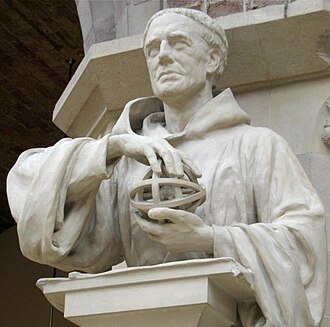
 AuthorRoger Bacon1220–1292
The Opus Majus (Latin for "Greater Work") is the most important work of the English philosopher, theologian and scientist Roger Bacon. He wrote it in Medieval Latin around 1267, at the request of Pope Clement IV, to explain the programme of study he had undertaken. It ranges across an broad field, from grammar and logic to mathematics, physics and philosophy, and modern editions run to roughly 840 pages.
Bacon sent the work to the Pope in 1267 with a dedicatory letter, which the monk and scholar Francis Aidan Gasquet later discovered in the Vatican Library and published in 1897. Bacon soon produced two companion works: the Opus Minus, a summary of the larger treatise, and the Opus Tertium, a preliminary introduction to both.
The book is divided into seven parts. The first examines the obstacles to true wisdom and sorts the causes of error into four kinds: weak authority, custom, the ignorance of others, and one's own ignorance disguised as knowledge. The second argues that theology, and Holy Scripture above all, is the foundation of every science. The third studies the biblical languages (Latin, Greek, Hebrew and Arabic), since revealed wisdom cannot be understood without them. Parts four to six cover mathematics, optics and experimental science; the fourth points out the errors of the Julian calendar, the fifth draws on Arab writers such as al-Kindi and Alhazen, and the sixth covers alchemy and gunpowder and anticipates devices such as microscopes, telescopes and spectacles. The seventh deals with moral philosophy.
Bacon conceived the work as a plea for reform addressed to the head of the Church, meant to improve the training of missionaries and to equip Christendom with new knowledge against its adversaries. An incomplete version appeared in London in 1733, edited by William Bowyer, and Samuel Jebb's later edition, based on a Cambridge manuscript, omitted the seventh part.
Themes
Original Filopedia text based on Wikipedia (es) and Wikipedia (en) and Wikidata.