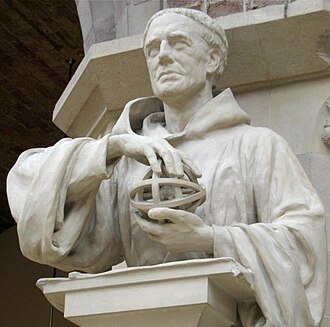
Roger Bacon
1220–1292 · English Franciscan philosopher, scientist and theologian
Origins and training
Roger Bacon was born in Ilchester, Somerset, England, in the early thirteenth century. His birth year is uncertain and has been put anywhere between about 1210 and 1220. The only direct evidence is a remark in the Opus Tertium of 1267, where he says that forty years had passed since he first learned the alphabet. His family seems to have been well off, though during the turbulent reign of Henry III they lost much of their property and several members were exiled.
He studied at Oxford, where he read Aristotle as part of the standard education of the day. There is no evidence that he ever received a doctorate; the title Doctor Mirabilis by which he is known was a posthumous honour.
The Paris years
Around 1237, or in the following decade, he went to the University of Paris, then the centre of European intellectual life. Aristotle's teaching there, which had recently been banned and was known mainly through Islamic commentators, had just been restored. After finishing his studies he taught as a master of arts, and he came into contact with Alexander of Hales and William of Auvergne.
Oxford and the study of nature
Around 1247 he left his post in Paris and, as a private scholar, spent the next decade in study, probably at Oxford and Paris. He was a pupil of Robert Grosseteste and Adam Marsh, and he commissioned expensive books, which then had to be copied by hand, as well as instruments. Around 1256 he took the Franciscan habit, after a decade of study that had left him physically and mentally exhausted.
In those years the two great orders, the Franciscans and the Dominicans, led theological debate. Bacon saw its limits: few teachers knew Greek, Aristotle circulated in poor translations, as did the Scriptures, and natural philosophy was argued from inherited authority rather than observation. He turned to the study of languages and experimental inquiry. The only master he respected was Peter Peregrinus of Maricourt, author of the treatise De Magnete. In his writings he attacked Alexander of Hales and other teachers whom he accused of gaining fame by teaching without real knowledge, and his combative temper brought him repeated trouble.
Enforced silence and a papal commission
In 1256 the scientific wing of the Franciscan order fell under Richard de Cornwell, with whom Bacon had clashed sharply. After 1260 Bacon's activities were restricted by a statute prohibiting friars from publishing without prior approval, and he was likely kept at menial tasks. A rule of his order forbade publication without special permission.
Cardinal Guy le Gros de Folques, who had become interested in his ideas, asked him for a complete treatise. When the cardinal was elected pope as Clement IV in 1265, he urged Bacon to write the work in secret and to disregard the prohibition. Bacon did so and sent the Opus Maius in 1267, a treatise on grammar, logic, mathematics, physics and philosophy. That same year he sent the Opus Minus, a summary of its main ideas, and in 1268 the Opus Tertium. Clement IV died later that year, and it is not certain that he ever read the full work.
Ideas and method
Bacon regarded himself as a follower of Aristotle, and to a large extent he was. He held that facts had to be gathered before scientific truths could be deduced, and that experience should displace mere argument from authority. His "experiments", however, were quite unlike modern research: they often drew on books from the scholastic tradition. His most recognisable contribution lies in optics, which he developed following Ibn al-Haytham, and in his insistence that empirical proof could overturn what Aristotle had said.
In theology he proposed reform. Theologians, he argued, should set aside minor philosophical distinctions and return to the Bible, learning the languages in which it was written. He himself knew several of these and denounced the corruption of the Scriptures and of the Greek philosophers through faulty translation. He also wanted natural philosophy to form part of theological training. The Opus Maius contains sections on mathematics, optics, alchemy and astronomy, including theories about the positions and sizes of the heavenly bodies. He is credited with recording the formula of gunpowder in Europe, though it had been invented earlier in China.
Imprisonment and last years
Tradition holds that around 1278 he was imprisoned by the Franciscans, probably on the orders of the minister general Jerome of Ascoli, amid his attacks on clergy and educators. Modern historians are more sceptical: the first reference to his imprisonment dates from some eighty years after his death and speaks only of unspecified "suspected novelties". If he was confined, the reason may have been his sympathy for the radical wing of the Franciscans on poverty, his interest in astrological doctrines, or his combative personality, rather than any specific scientific novelty.
He is believed to have returned to the Franciscan house at Oxford, where he went on studying. His last dated writing is from 1292, the year he died, probably at Oxford. He had no distinguished disciples and for a long time was largely forgotten.
Reception and legacy
In the early modern period he was remembered as a magician, above all for the legend of a brazen head endowed with mechanical or necromantic powers. Present-day scholars tend to see him as an essentially medieval thinker whose experimental knowledge came largely from books. Even so, he is credited with helping bring optics into the university curriculum and with an early defence of empirical method. His most famous saying is that "mathematics is the door and key to the sciences". He is still commemorated in the lunar crater Baco, the asteroid (69312) Rogerbacon, and in Umberto Eco's novel The Name of the Rose, where Brother William of Baskerville is among his ardent admirers.
Key ideas
- Empiricism and experience: true knowledge must be tested by observing things, not only by the authority of texts.
- Criticism of authority: masters should not accept inherited opinions without checking them, and sources should be read in their original languages.
- Reform of theology: theologians should focus on the Bible and learn Greek, Hebrew and other languages to avoid translation errors.
- Unity of learning: the sciences, especially mathematics, optics and language, are a necessary part of the study of philosophy and theology.
Works in Filopedia
- Opus Majus 1267
Curiosities
A posthumous nickname
The title Doctor Mirabilis was given after his death, as there is no evidence that he ever obtained a doctorate.
The gunpowder formula
Although gunpowder was first invented in China, Bacon was the first in Europe to record its formula.
Original Filopedia text based on Wikipedia (es) and Wikipedia (en) and Wikidata.