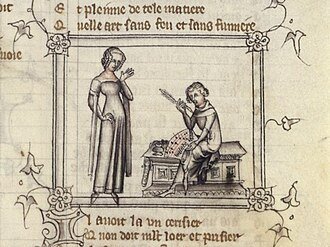
 AuthorGuillaume de Machaut1300–1377
The Messe de Nostre Dame (Mass of Our Lady) is a polyphonic mass composed by the French poet, musician and cleric Guillaume de Machaut (c. 1300-1377) before 1365. Machaut was a canon of the cathedral of Reims, and the work is generally assumed to have been written for that church. It is regarded as one of the masterpieces of medieval music and of all religious music. It is also historically notable as the earliest complete setting of the Ordinary of the Mass attributable to a single composer, in contrast to earlier compilations such as the Tournai Mass, in which each movement was written independently by a different composer.
The specific circumstances of its composition are not documented. A persistent but unsupported legend links it to the coronation of King Charles V of France in 1364. Some scholars propose that Machaut did not actually take up his post at Reims until the late 1350s, and that the mass may have been an act of devotion marking his arrival. In line with the wills of Guillaume and his brother Jean, also a canon at the cathedral, the mass is thought perhaps to have later served as a memorial service for them, though this too is not conclusively established.
The work has six movements: Kyrie, Gloria, Credo, Sanctus, Agnus Dei, and the dismissal Ite, missa est. Machaut wrote it for four voices rather than the usual three, adding a countertenor that moves in the low range, sometimes taking over as the lowest voice. The Kyrie is built on a Gregorian chant, and the Sanctus, Agnus Dei and Ite also draw on liturgical melodies, while the Gloria and Credo have no evident chant basis but are stylistically related to each other. This stylistic coherence is what makes the work remarkable: Machaut conceived the items of the Ordinary as an artistic whole, something unusual at a time when they were performed separately, interspersed with prayers and chants.
The manner of performance is also uncertain. The voices were probably doubled by instruments, and some passages, such as the short textless interludes in the Gloria and Credo, may have been played instrumentally alone. Its influence was considerable, as it is seen as a precursor of later polyphonic masses that treated the Ordinary as a unified whole. Since the mid-twentieth century it has been recorded many times, which has helped bring it beyond specialist circles.
Themes
Original Filopedia text based on Wikipedia (es) and Wikipedia (en) and Wikidata.