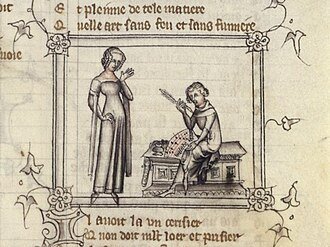
Guillaume de Machaut
1300–1377 · French clergyman, poet and composer
Guillaume de Machaut (c. 1300-1377) was a French clergyman, poet and composer who wrote in French and dominated the music of his time. He is regarded as the leading figure of the Ars nova, the movement that reshaped polyphonic music in the fourteenth century, and as one of the most influential creators of the late Middle Ages. His significance lies in linking the tradition of the troubadours and trouvères with the polyphony that followed.
He was born around 1300, most likely in or near Reims, and his surname may come from the nearby town of Machault in the Ardennes. From 1323 to 1346 he served as secretary to John I of Luxembourg, King of Bohemia, travelling with him on journeys and military campaigns, including a visit to Prague. In those years he also held canonries at Verdun, Arras and Reims. After the king's death at Crécy in 1346, he entered the service of other nobles, among them the king's daughter Bonne of Luxembourg and Charles II of Navarre.
He survived the Black Death and spent his last years in Reims, where he oversaw the copying of manuscripts containing his complete works. This is why so much of his music has come down to us.
His poetic output is vast, roughly 400 fixed-form poems, among them 235 ballades and 76 rondeaux. He refined and systematised these forms. Although he usually wrote the words before setting them to music, he regarded poetry as the more important craft. Many of his poems are dits, first-person narratives in octosyllabic rhyming couplets, full of allegorical dreams and a lover trying to win back his lady, following the conventions of the Roman de la Rose. His main subject is courtly love, though he also wrote about war, consolation and moral philosophy. His habit of casting himself as the narrator allowed him to present his own outlook on the world.
In music he composed lais, virelais, motets, ballades and rondeaux. His Mass of Our Lady, in four movements, is the earliest known complete setting of the Mass Ordinary by a single composer, although scholars still debate whether it was conceived as a cyclic work. As a poet-composer, he was admired and imitated by Geoffrey Chaucer and Eustache Deschamps, and his reputation stayed high well into the fifteenth century. His legacy is twofold: he closed the era of the medieval poet-musician and gave the Mass a musical unity that anticipated later composers.
Key works
- Mass of Our Lady (Messe de Nostre Dame, early 1360s): the first complete Mass Ordinary by a single composer, in four movements.
- The Cure of Ill Fortune (Le remède de fortune, c. 1340s-1357): a dit in which the narrator, questioned by his lady, finds consolation and advice in an allegorical garden.
- A True Story (Le livre du voir dit, c. 1361-1365): a long work full of letters and poems, often read as autobiographical.
- The Judgement of the King of Navarre (Le jugement du roi de Navarre, 1349): an allegorical debate between a knight and a lady over who has suffered more in love.
Works in Filopedia
Curiosities
A copyist under his eye
In his last years in Reims, Machaut personally oversaw the making of manuscripts containing his complete works. This is why an unusually large body of his music survives from his time.
A disputed romance
His poem Le livre du voir dit seems to recall an earlier love affair with Péronne d'Armentières, a nineteen-year-old girl. How far the work is autobiographical remains disputed.
Elegies after his death
When he died in 1377, other composers, including François Andrieu, wrote elegies lamenting his passing.
Original Filopedia text based on Wikipedia (es) and Wikipedia (en) and Wikidata.