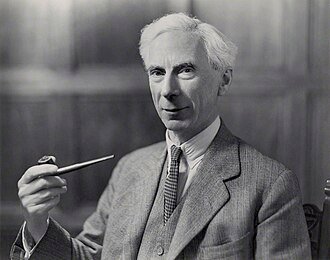
 AuthorBertrand Russell1872–1970
Marriage and Morals is an essay published in 1929 by the British philosopher, mathematician and Nobel laureate Bertrand Russell. In it he questions the Victorian morality and puritanism that dominated Western society at the time in matters of sex, love and marriage, and proposes a new sexual ethics whose only criterion is human happiness.
The book is made up of twenty chapters. After an introduction, Russell traces the history of human relationships from a prehistoric perspective, examining patriarchal and matriarchal models in different eras and places. He then turns to Christian ethics regarding sex, romantic love and the emancipation of women, which he regards as a driving force of moral change. He also addresses the taboo surrounding sex education, prostitution and pornography, and devotes several chapters to the concept of the family from social, individual and psychological viewpoints, as well as to the relationship between family and state. He defends the legalisation of divorce, which was forbidden in many jurisdictions, and closes with reflections on population, contraception, eugenics and the place of sex among human values.
His central thesis is that sexual conduct concerns the community only when children are involved, and that this case must be regulated to protect the most vulnerable. Russell criticises moralists who celebrate continence as a virtue, condemn extramarital relations and denounce contraception. He holds that traditional morality arose from the need of patriarchal societies to secure paternity and from a primitive asceticism that equated pleasure with sin, and that both reasons have lost their force. He proposes a marriage founded on mutual love that embraces the whole personality of both partners, and accepts infidelity as a natural fact when love cannot rest on fear or coercion. He also advocates better sex education for all social classes.
The book further anticipates the gradual assumption by the state of functions once held by the father, such as educating children or providing for their upkeep, and reflects on demographic pressure and the uneven distribution of births among the world's regions, which Russell links to possible conflict. Its reception was initially favourable and later highly controversial. Because of these ideas, Russell lost his professorship at the City College of New York in 1940, after a court ruling declared him morally unfit to teach. Today it is regarded as one of his most notable essays, and the author himself claimed that it helped earn him the 1950 Nobel Prize in Literature, although the Nobel Foundation praised his body of work as a whole rather than that book in particular.
Themes
Other works by Bertrand Russell
- The Principles of Mathematics 1903
- The Problems of Philosophy 1912
- Principia Mathematica 1917
- Introduction to Mathematical Philosophy 1919
- The Conquest of Happiness 1930
- In Praise of Idleness and Other Essays 1935
- Power: A New Social Analysis 1938
- A History of Western Philosophy 1945
- My Philosophical Development 1959
Original Filopedia text based on Wikipedia (es) and Wikipedia (en) and Wikidata.