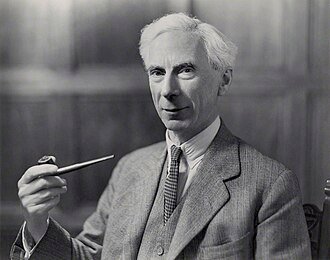
 AuthorBertrand Russell1872–1970
A History of Western Philosophy is a 1945 book by the British philosopher Bertrand Russell. It surveys Western philosophy from the pre-Socratic thinkers to the currents of the early twentieth century. The book grew out of a series of lectures Russell gave at the Barnes Foundation in Philadelphia in 1941 and 1942, and much of the preparatory research was carried out by his third wife, Patricia. Russell wrote the text between 1940 and 1943, mostly while living in Pennsylvania, on an advance of 3,000 dollars from his publishers. It appeared first in the United States and a year later in the United Kingdom. A 1961 edition reset the text without adding new material.
The work is arranged in three books. The first covers ancient philosophy: the pre-Socratics, Socrates, Plato and Aristotle, and the philosophy that followed Aristotle, including the Cynics, Sceptics, Epicureans, Stoics and Plotinus. The second turns to Catholic philosophy, from the Church Fathers, with Saint Augustine at the centre, to the Schoolmen, with Thomas Aquinas. The third traces modern philosophy, from the Renaissance and Hume to Rousseau, Kant, Hegel, Schopenhauer, Nietzsche, Marx, Bergson, William James and John Dewey, and closes with a chapter on logical analysis, which concerns Russell's own views. Each major division opens with an account of the historical background, a feature Russell stressed: he wanted the ideas to be understood in relation to their time, and he described his aim as a history of culture.
Academic reception was mixed. Reviewers praised the clarity and wit of the prose but pointed to overgeneralisations, omissions and an uneven treatment that dwelt more on ancient and medieval thought than on the contemporary period. Some felt the author never settled whether he was writing history or polemic. Russell answered that the book should be read as social history. Albert Einstein admired it, and the Nobel committee that awarded Russell the Prize in Literature in 1950 cited it among the works that earned him the honour. Its commercial success gave Russell financial security in the last part of his life, and the book has remained in print since its first publication. Over the years critics have noted factual slips, contestable judgements about Hegel and Kant, and the absence of Heidegger, yet it remains one of the most widely read introductions to the history of philosophy.
Themes
Other works by Bertrand Russell
Original Filopedia text based on Wikipedia (es) and Wikipedia (en) and Wikidata.