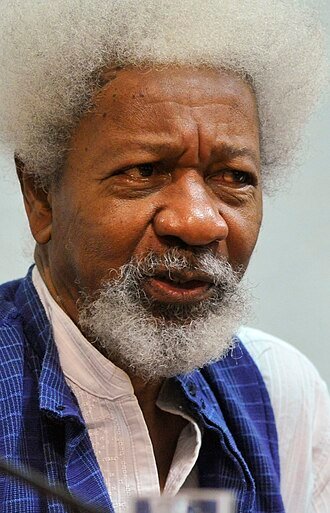
 AuthorWole Soyinkab. 1934
The Interpreters is a novel by Nigerian writer Wole Soyinka, first published in London by André Deutsch in 1965 and later reissued in the influential Heinemann African Writers Series. It is the first of only three novels Soyinka wrote; he is known mainly as a playwright. Written in English, it was later translated into a number of languages.
The story is set in the 1960s, in Nigeria after independence and before the civil war, mainly in Lagos. Its five central characters are Egbo, a clerk in the foreign ministry, Bandele, a university professor, Sagoe, a journalist, Sekoni, an engineer turned sculptor, and Kola, an artist. They were friends at high school, went abroad to study, and returned to take up middle-class jobs in Nigeria.
The narrative seems chaotic, with a non-linear structure that often returns to past events, so grasping the main characters, especially Egbo and Sagoe, demands close attention. Many other figures, such as the professors and the editorial board of the newspaper where Sagoe works, are drawn schematically in line with the stereotypes of the period. Soyinka aimed to resist the conventional tropes of the post-colonial novel.
Critics received the book with reservations. Thomas Lask, writing for The New York Times, objected to its "diffuse" construction, though he praised its blend of aesthetic and political problems. The novel has been called "difficult" and is said never to have received the attention it deserved.
Themes
Other works by Wole Soyinka
Original Filopedia text based on Wikipedia (en) and Wikidata.