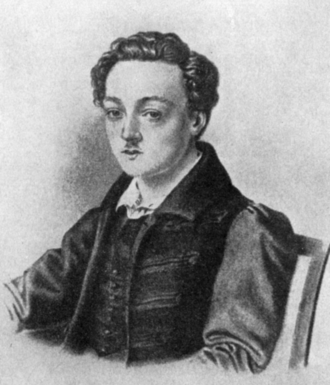
 AuthorGeorg Büchner1813–1837
Leonce and Lena is a play by the German dramatist Georg Büchner (1813–1837). Although it is considered a comedy, its core is a satire disguised as humor. Büchner wrote it in the spring of 1836 for a competition for the best one- or two-act comedy in prose or verse, sponsored by the Stuttgart publisher Cotta. However, he missed the submission deadline, and the play was returned unread.
It was first performed almost sixty years later, on 31 May 1895, in an outdoor production by the Munich company Intimes Theater, directed by Ernst von Wolzogen, with the involvement of Max Halbe and Oskar Panizza. That delay reflects the fact that Büchner gained recognition as a writer only in the twentieth century. Erich Kästner regarded it as one of the six most important classic comedies in the German language.
The action takes place in two imaginary kingdoms, Popo and Pipi, names drawn from children's language meaning buttocks and urine. Prince Leonce of Popo and Princess Lena of Pipi have a political marriage arranged for them. Leonce, weary of a hollow courtly life, and Lena, who does not want to marry a stranger, each flee their kingdoms toward Italy. Along the way they meet by chance at an inn, fall in love, and resolve to marry. On their return, King Peter, unable to stage the wedding, substitutes the couple with two famous automatons that had been accompanying them in disguise; when the masks come off, the true identities of the pair are revealed.
The play poses a central question: whether fate governs events or chance does. Leonce and Lena believe they escape their destiny, yet they end up fulfilling what their parents wanted, and the encounter that seems accidental can be read as a sign of fate. Büchner gives little attention to the love story, suggesting that his real interest lies in the power of destiny rather than romance. The hedonistic Valerio and the muddled bureaucrat King Peter complete a critique of monarchical convention and the heaviness of power.
Themes
Other works by Georg Büchner
- The Hessian Courier 1834
- Danton's Death 1835
- Lenz 1839
- Woyzeck 1875
Original Filopedia text based on Wikipedia (en) and Wikidata.