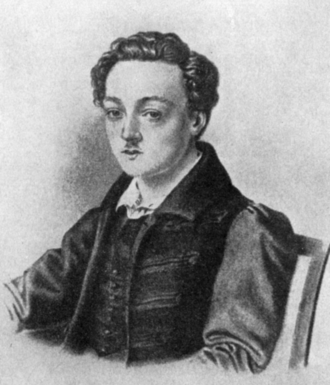
Georg Büchner
1813–1837 · German dramatist and prose writer
Karl Georg Büchner (1813–1837) was a German dramatist and prose writer, associated with the Young Germany movement and with radical politics in the 1830s. He died at twenty-three, yet his plays shaped naturalism, expressionism and later European theatre. For that reason he is often placed beside Goethe and Schiller as a writer who, had he lived longer, might have reached a comparable stature.
He was born in Goddelau, in the Grand Duchy of Hesse, the son of a physician who had served as a military surgeon in Napoleon's armies. The household valued science and literature, and his father's atheist, materialist outlook shaped both Georg and his brother Ludwig, who later became a philosopher. He began studying medicine in Strasbourg in 1831, where he read French literature and absorbed the utopian socialist ideas of Babeuf and Saint-Simon. Back in Hesse he founded a secret society and, in 1834, together with the pastor Friedrich Ludwig Weidig, wrote The Hessian Courier, a pamphlet denouncing social injustice and urging the peasantry to rise, with the line «Peace to the cottages, war to the palaces». The authorities charged them with treason. Weidig died in prison after being tortured, and Büchner fled to Strasbourg in 1835, having finished Danton's Death while hiding at his parents' home.
In Strasbourg he also translated two plays by Victor Hugo and submitted a dissertation on the nervous system of the barbel, earning his doctorate. In 1836 he moved to Zurich to teach, and there he wrote Leonce and Lena, a comedy that satirises the nobility, and worked on Woyzeck. That drama survives only in fragments, so its intended ending is unknown. He died of typhus in February 1837.
His work breaks with classical form: short scenes, marginal characters and a view of society in which ordinary people are crushed by forces they cannot control. Lenz, a novella based on the life of the Sturm und Drang poet Jakob Michael Reinhold Lenz, explores a disturbed mind in a prose that Arnold Zweig called the beginning of modern European prose. Woyzeck inspired Alban Berg's opera Wozzeck, premiered in 1925, and the German literary Georg Büchner Prize, created in 1923, bears his name.
Key ideas
- Social revolution: the struggle between rich and poor as the only truly revolutionary struggle, with the rising of the peasantry as the engine of change.
- Life as an end in itself: in a school essay defending Cato's suicide, he argued that life is not merely a passage toward a afterlife paradise.
- Drama of the marginal: in Woyzeck and Danton's Death, the conflict arises from social and political forces that crush the individual.
- Satire of the nobility: in Leonce and Lena he questions aristocratic privilege with irony and brief, sharp scenes.
Where to start
Danton's Death 1835
Danton's Death is his first play and the best entry point: a historical drama set during the French Revolution, written in vivid prose. The reader will find the clash between Danton and Robespierre, and a reflection on power, political violence and human frailty before history.
Next: Woyzeck. Woyzeck, his unfinished play, shares the same critical gaze on power but follows a humble man's life, and it is one of the great texts of modern theatre.
Works in Filopedia
- The Hessian Courier 1834
- Danton's Death 1835
- Leonce and Lena 1836
- Lenz 1839
- Woyzeck 1875
Books to read
- Woyzeck GermanEPUB 92 KBRead online
Curiosities
A father who served Napoleon
His father had worked for five years as a military surgeon in Napoleon's armies before becoming a doctor in Goddelau.
A very radical pamphlet
The Hessian Courier has been called the most revolutionary manifesto of the nineteenth century, preceding The Communist Manifesto.
An opera born from Woyzeck
The unfinished play Woyzeck became the basis for Alban Berg's opera Wozzeck, which premiered in 1925.
Original Filopedia text based on Wikipedia (es) and Wikipedia (en) and Wikidata.