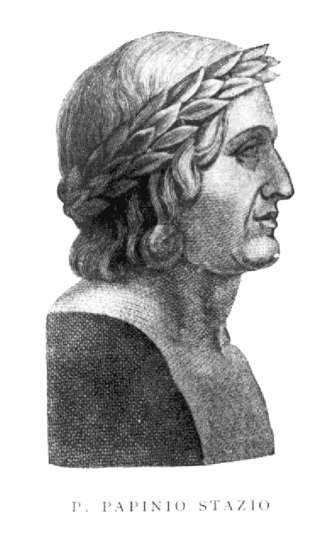
 AuthorPublius Papinius Statius45–96
The Thebaid is a Latin epic poem by the Roman poet Statius, published in the early 90s AD after roughly twelve years of work. It runs to about 9,700 lines in twelve books and recounts the struggle between the brothers Eteocles and Polynices for the throne of Thebes, the Greek city traditionally founded by Cadmus.
The story opens with Oedipus, already deposed, cursing his sons after learning that he had killed his father Laius and married his mother Jocasta. An agreement to share the kingship breaks down, Polynices goes into exile, allies himself with Adrastus of Argos and other princes, and leads an expedition against his brother. Statius follows the conventions of classical epic: gods intervene openly in human affairs, the preparations for war are described, a catalogue of the fighting forces is included, and funeral games are held in honour of the child Opheltes, an episode that serves as the origin of the Nemean Games. Statius imitates Virgil closely, both in episodes and in diction, and the poem also has strong ties to the tragedies of Seneca the Younger.
Its central concerns include the tension between politics and family, civil war, and the amoral acts it provokes. Its episodic structure, held together by subtle links between scenes, recalls Ovid's Metamorphoses, and critics have praised its innovative treatment of Roman mythology.
The poem was not widely read in antiquity, but it was greatly admired throughout the Middle Ages, when several vernacular adaptations were produced. After a period of reduced esteem in the nineteenth and early twentieth centuries, when it was faulted for lack of originality and taste, renewed critical interest has brought it back toward the centre of the literary canon.
Themes
Other works by Publius Papinius Statius
Original Filopedia text based on Wikipedia (es) and Wikipedia (en) and Wikidata.