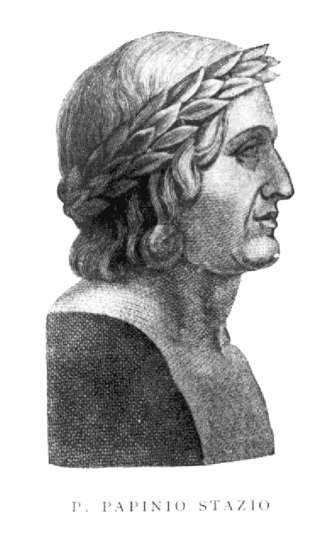
 AuthorPublius Papinius Statius45–96
The Achilleid is an unfinished Latin epic by Publius Papinius Statius recounting the life of Achilles. Probably composed between 94 and 96 CE, it was meant to cover the hero's story from youth to his death at Troy, but Statius completed only about one and a half books, around 1,127 hexameters, before dying, most likely in late 95 or early 96. The dating rests on references in the Silvae, Statius' collection of occasional poems: he complains there of lacking the impetus to continue without his friend C. Vibius Maximus, to whom the poem is addressed, and shortly afterwards announces a public recitation of an excerpt.
The first book shows Achilles in Thessaly, raised by the centaur Chiron, before his mother Thetis takes him, disguised as a girl, to the island of Scyros at the court of King Lycomedes, to keep him from the Greek expedition. There he falls in love with Deidamia, one of the king's daughters, and reveals his identity when Ulysses and Diomedes present martial gifts. The shorter second book follows his departure and the conversations on the voyage, in which Achilles recalls his youth and Chiron's teachings, and the poem breaks off abruptly.
Statius aimed to revise the Homeric image of Achilles, much as Ovid had done with Virgil's Aeneas, and he departs from the solemn tone of the Thebaid for a more playful, sentimental manner, with considerable emphasis on feminine emotion and Thetis's maternal anxiety. His chief model is the Epic Cycle, which he signals by asking the Muse not to stop at Hector's death. The work was admired in the Renaissance, and its story of the hero in women's dress inspired Baroque operas across Europe, among them La finta pazza, staged in Venice in 1641, and Achille in Sciro, in Ferrara in 1663.
Themes
Other works by Publius Papinius Statius
Original Filopedia text based on Wikipedia (es) and Wikipedia (en) and Wikidata.