The Open Society and Its Enemies
two-volume work of political philosophy · 1945
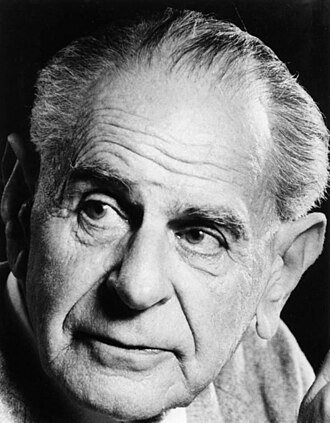 AuthorKarl Popper1902–1994
The Open Society and Its Enemies is a work of political philosophy written by Karl Popper during the Second World War, while he was living in New Zealand, far from the European academic centres. Unable to find a publisher in the United States, the book first appeared in London in 1945, published by Routledge in two volumes. Its aim is twofold: to defend the open society, a political order grounded in critical freedom and democratic institutions, and to challenge the doctrines that Popper believed threatened it, above all historicism, the belief that history unfolds inexorably according to universal laws that would allow us to predict humanity's destiny.
Popper argues that historicism provided the intellectual foundation for the twentieth-century totalitarianisms, both fascist and communist. To demonstrate this, he examines three major thinkers whom he accuses of holding such a view, in different degrees: Plato, Hegel and Marx. He chose them because he considered them the most influential enemies of democracy. The work is divided into two volumes: the first, "The Spell of Plato", and the second, "The High Tide of Prophecy", devoted to Hegel and Marx. Against the common reading that praised Plato as a benevolent philosopher, Popper contends that his blueprint for an ideal state, with its selected ruling class and rigid discipline, anticipates a totalitarian nightmare. His conclusion is that only liberal democracy allows institutions to be improved without violence.
The book provoked intense debate. The philosopher Sidney Hook praised it as a carefully argued critique of historicism, though he faulted Popper for reading Plato too literally and for treating Hegel unfairly. Leo Strauss questioned whether the ideal city of the Republic could be understood as a programme of political reform. Other writers, such as Walter Kaufmann, argued that Popper's readings of Hegel were simplified and incomplete. Over time the work became a reference for the defence of pluralism and critical liberalism, and its name inspired the Open Society Foundations founded by George Soros.
Themes
Other works by Karl Popper
Original Filopedia text based on Wikipedia (es) and Wikipedia (en) and Wikidata.