The Poverty of Historicism
essay in philosophy of science and social science · 1957
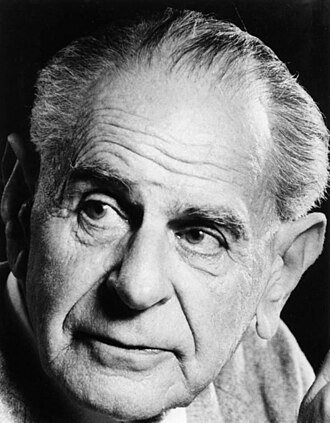 AuthorKarl Popper1902–1994
The Poverty of Historicism is a book by the Austrian-born philosopher Karl Popper. It began as a paper read in 1936, was revised and published in a series of articles in the journal Economica in 1944, and appeared in English as a book in 1957. Popper dedicated it to the countless people who fell victim to fascist and communist belief in inexorable laws of historical destiny. The title alludes to Marx's The Poverty of Philosophy (1847), itself a response to Proudhon's The Philosophy of Poverty (1846).
The book is a treatise on scientific method in the social sciences. Popper defines historicism as an approach that takes historical prediction to be the principal aim of social science, and he identifies its central doctrine as the belief that social science should uncover the laws of social evolution in order to foretell the future. He distinguishes two strands: a "pro-naturalistic" current, which favours applying the methods of physics to history, and an "anti-naturalistic" current, which rejects those methods. The first two parts of the book expound both positions and the last two criticise them. Popper closes by contrasting the ancient roots of historicism, traditionally traced to Plato, with the claims to modernity made by its twentieth-century advocates.
His critique works on three levels. First, the idea itself is flawed: a complete description of society is impossible, human history is a unique sequence of events rather than a repeatable law-governed process, individual human action cannot be predicted with certainty, and the course of history depends partly on future scientific knowledge, which cannot be known in advance. Second, historicists are inconsistent: they call for remodelling human beings to suit the future society, they fail to imagine the conditions under which a trend would cease, they mistake historical interpretations for theories, and they confuse ends with aims. Third, the practical consequences are harmful: large-scale social experiments produce unintended effects, and by centralising power and suppressing dissent they deprive society of the information it needs to correct its mistakes.
In place of historicism, Popper proposes "piecemeal social engineering", which makes small, reversible changes whose effects can be observed and tested. He acknowledges that historicism has the merit of challenging the view that history is shaped only by great men.
The book was widely discussed. The anti-communist writer Arthur Koestler called it probably the only book published that year that would outlive the century, and the libertarian theorist Tom G. Palmer has described it as brilliant. Popper's use of the word "historicism", however, has been criticised for departing from its ordinary meaning among historians, for whom it usually denotes a cautious, interpretive method rather than a predictive one. The Marxist philosopher Karel Kosík contested Popper's view of abstract knowledge against what he called the concrete totality of reality.
Themes
Other works by Karl Popper
Original Filopedia text based on Wikipedia (en) and Wikidata.