The German Ideology
work of philosophy and social criticism by Karl Marx and Friedrich Engels · 1932
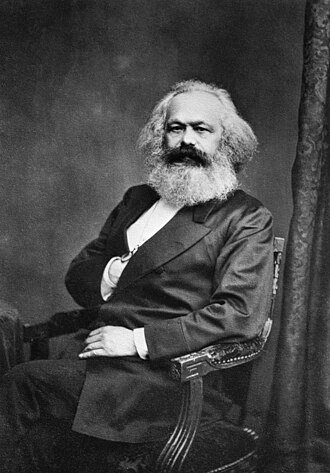 AuthorKarl Marx1818–1883
The German Ideology is a text written by Karl Marx and Friedrich Engels in Brussels between 1845 and 1846. It came about after Marx was expelled from Paris, accused of writing revolutionary articles for the radical newspaper Vorwärts!, and after Engels joined him in Brussels. Following a trip to England to study the country's economists, the two men wrote the work as a settling of accounts with the philosophy of their time and as a way of clarifying their own ideas.
The book was never published during its authors' lifetimes. Attempts to find a publisher in Germany failed, partly because of police censorship and partly because publishers sympathized with the philosophical currents that Marx and Engels attacked. Marx later summed up the abandonment of the manuscript with a famous phrase: they had left it to "the gnawing criticism of the mice", since they had already achieved their main aim, the clarification of their own ideas. The version we know today is an editorial construction based on disordered and unfinished manuscripts, first published in full in 1932 by the Marx-Engels Institute in Moscow.
The text marks Marx and Engels's definitive break with German idealism and lays the foundations for their later works, such as The Communist Manifesto and Capital. It is considered the first work that can be recognized as Marxist. It contains the first formulation of the materialist conception of history: the foundation of society is the material conditions of people's lives, that is, their mode of production, and consciousness and ideas are products of that reality and not the reverse. From this comes the formulation that life is not determined by consciousness, but consciousness by life.
The book is usually divided into three parts. The first, devoted to Feuerbach, contains the most systematic exposition of historical materialism and is the most widely read section, often read on its own. The second and third parts are detailed and sometimes satirical polemics against Bruno Bauer, Max Stirner and the proponents of "True Socialism". Marx and Engels accused these Young Hegelians of waging a purely philosophical struggle against phrases, rather than criticizing the material world from which those phrases arose.
The manuscript remained incomplete and unrevised. It was first published in 1932, by which time Lenin had died, Rosa Luxemburg had been murdered and Gramsci was in prison, so some of the most important Marxist theorists never came to know its ideas. Since then it has been decisive for understanding the development of Marx's thought, his break with Feuerbach and the genesis of historical materialism.
Themes
Other works by Karl Marx
Original Filopedia text based on Wikipedia (es) and Wikipedia (en) and Wikidata.