Capital: A Critique of Political Economy
treatise on political economy and social critique in three volumes · 1867
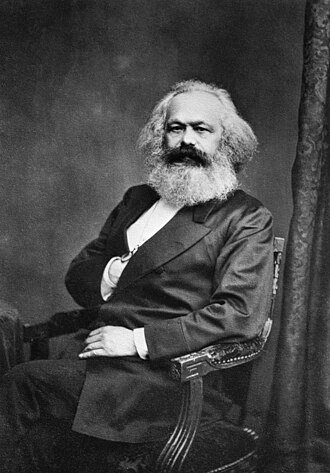 AuthorKarl Marx1818–1883
Capital: A Critique of Political Economy is Karl Marx's principal work and one of the most influential theoretical texts in modern philosophy, economics and politics. Marx conceived it as a critical investigation of political economy aimed at uncovering the laws that govern the capitalist mode of production, understood not as a simple description of an economic model but as a historical epoch with a traceable origin, development and eventual decline. Its making was long: between 1861 and 1863 Marx worked intensively on a large manuscript, and over roughly twelve years he studied the available economic literature, largely in the British Library in London. Only the first volume appeared in his lifetime, in German, in 1867. The second and third volumes were assembled by Friedrich Engels from Marx's manuscripts and published in 1885 and 1894; a fourth, Theories of Surplus Value, was edited by Karl Kautsky.
The central argument is that the force driving capitalism is the exploitation of labour: unpaid work is the ultimate source of surplus value and profit. Marx holds a labour theory of value, according to which a commodity's value depends on the socially necessary labour time needed to produce it. He distinguishes labour power, which the worker sells as a commodity, from its use-value, its capacity to create more value than the wage it earns. From this follow capital accumulation, technological change, the formation of a reserve army of labour and a long-term tendency for the rate of profit to fall, which produces recurrent crises and intensifies class conflict. A further key concept is commodity fetishism, by which social relations between people take the appearance of objective relations between things.
To build his critique, Marx engaged with the classical economics of Adam Smith and David Ricardo, with Hegel's dialectic, which he turned from idealist into materialist form, and with French utopian socialism. His method combined a "descending path" from appearances to essence with an "ascending path" that reconstructs the concrete totality from abstract concepts. The first volume deals with production and exploitation, the second with the circulation of capital, and the third with the process as a whole, including the distribution of surplus value into profit, interest and rent.
Capital is among the most cited works in the social sciences. It shaped the international labour movement, socialist and communist parties, and disciplines including sociology, political science and philosophy, and it became central to Western Marxism. Since publication it has been widely debated and criticised, especially regarding the labour theory of value, its predictions about capitalism's future and its association with the communist states of the twentieth century. UNESCO inscribed its first volume, together with the Communist Manifesto, in its Memory of the World Programme in 2013.
Themes
Books to read
- El capital: Resumido y acompañado de un estudio sobre el Socialismo científico SpanishEPUB 320 KBRead online
Other works by Karl Marx
Original Filopedia text based on Wikipedia (es) and Wikipedia (en) and Wikidata.