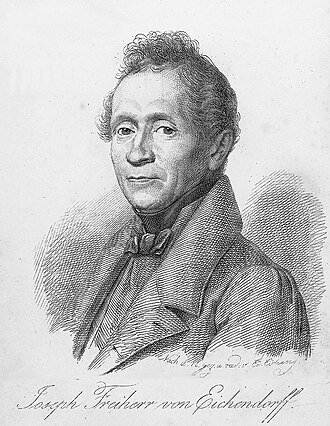
 AuthorJoseph von Eichendorff1788–1857
The Marble Statue is a novella by the German writer Joseph von Eichendorff, published in 1818. Set around Lucca, in Italy, it follows a young man named Florio, who struggles to choose between two worlds: that of piety, represented by a musician and a beautiful young woman, and that of art, embodied in a statue of Venus.
The story begins on a summer night during festivities near the gate to Lucca. Florio meets the famous musician Fortunato, a lovely young woman named Bianca, and the eloquent cavalier Donati, who greets him as an old friend and knows details of his youth that Florio cannot recall. Taking a walk at night, he finds a statue of Venus that seems strangely familiar and, at the same time, alarming. Soon afterwards he sees, in an extravagant garden, a singing lady whose features resemble those of the statue. Through festivities, riddles and apparitions, the plot moves toward an unsettling scene in the lady's palace, interrupted by a thunderstorm and by Florio's prayer, after which the landscape itself seems to change.
Eichendorff builds the work in a fragmentary, dreamlike manner typical of the late Romanticism of his time. His main target is the Romantic tendency to treat art as a religion. To this end he draws on the Venusberg myth, in which Venus seduces men and draws them away from Christian life, and updates it. The novella was first published in the Frauentaschenbuch of 1819 and later in a volume with other works. It was criticised in its day for being fantastical and confusing; in the twentieth century it was read as an overly rigid clash between Christianity and paganism, and today critics value above all the ambiguity of its elements and the erotic imagery that undermines its apparent moral. Othmar Schoeck's opera Venus (1922) is based on it.
Themes
Other works by Joseph von Eichendorff
Original Filopedia text based on Wikipedia (en) and Wikidata.