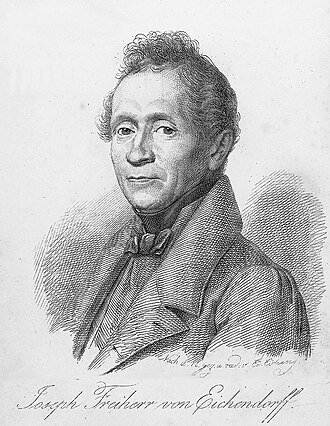
Joseph von Eichendorff
1788–1857 · German poet and novelist of Romanticism
Joseph von Eichendorff (Lubowitz, 1788 – Neisse, 1857) was a German poet and novelist and one of the central figures of Romanticism in the German language. Born in Upper Silesia, then part of the Kingdom of Prussia, he wrote in German. His simple, musical lyrics are still read and sung two centuries later, and they remain one of the main ways Romanticism reached a wide audience.
He came from an old Catholic noble family. He grew up at Lubowitz Castle, where he was taught at home alongside his brother Wilhelm, and he soon began keeping a diary that recorded everything from the weather to the family's debts. He studied law and the humanities at Halle and Heidelberg, cities linked to early Romanticism, and in Heidelberg he came to know Achim von Arnim and Clemens Brentano. After an educational journey through Paris, Vienna and Berlin, he returned to Silesia to help his father manage the estate.
His life was far from that of a wandering poet. He fought against Napoleon in the war of liberation, married Luise von Larisch in 1815 and had children, some of whom did not survive childhood. The family's financial ruin, worsened by the sale of its properties, led him to take up posts in the Prussian civil service from 1816, in Breslau, Danzig, Königsberg and Berlin, until his retirement in 1844. He spent his final years in Silesia and at Neisse, where he died in 1857.
His style blends the plainness of folk song with a way of seeing landscape as an emotional space. Recurring themes include the forest, travel, unrequited love and nostalgia for a lost world. His best-known novel, Memoirs of a Good-for-Nothing (1826), follows a young man who leaves his father's mill trade and ends up in love in Vienna. Many of his poems are embedded in the prose, and characters sing them. He became known as the 'singer of the German forest'.
His legacy is chiefly lyrical. Composers including Schumann, Mendelssohn, Brahms, Wolf and Strauss set his verses to music, and his way of depicting nature helped shape popular feeling for the German landscape.
Key works
- Presentiment and Present (1815), a novel about a young nobleman's search for identity during a time of change.
- The Marble Statue (1819), a tale of fantastic tone about an encounter with a marble statue.
- Memoirs of a Good-for-Nothing (1826), his most famous novella, about a young wanderer who sets out into the world in search of fortune and love.
- Schloss Dürande (1836), a story about a noble family facing revolution and social change.
Where to start
Memoirs of a Good-for-Nothing 1826
Aus dem Leben eines Taugenichts is a short novel that is accessible and luminous, a landmark of the musical prose of German Romanticism. Its wandering, carefree protagonist moves through landscapes, songs and encounters, and the reader will find in it the light, lyrical and nostalgic tone that defines Eichendorff.
Next: The Marble Statue. Die Marmorstatue (The Marble Statue) broadens Eichendorff's Romantic universe with a more intense conflict between two worlds, offering a rich contrast to the lightness of the first tale.
Works in Filopedia
Books to read
- Aus dem Leben eines Taugenichts: Novelle GermanEPUB 153 KBRead online
Curiosities
A diary from adolescence
In 1801, at thirteen, he noted in his diary that his father had travelled to Breslau to escape his creditors. He was already aware of his family's financial troubles.
A praise from Thomas Mann
Thomas Mann described *Memoirs of a Good-for-Nothing* as a combination of 'the purity of the folk song and the fairy tale'.
Original Filopedia text based on Wikipedia (es) and Wikipedia (en) and Wikidata.