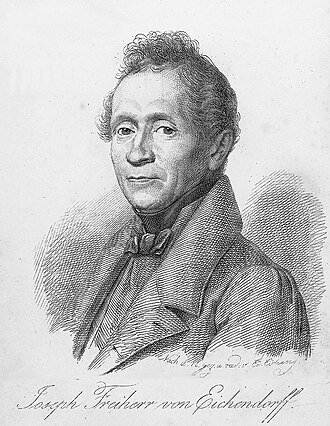
 AuthorJoseph von Eichendorff1788–1857
Aus dem Leben eines Taugenichts is a novella by Joseph von Eichendorff, completed in 1823 and published in 1826. It is regarded as one of the high points of musical prose in German Romanticism. Eichendorff built an open form combining epic and lyrical elements, and the text includes several poems and songs.
The story begins when a miller sends his son away, calling him a good-for-nothing. The young man sets off with his fiddle, happy and without a fixed destination. Soon two ladies travelling in a carriage, charmed by his music, take him to their palace near Vienna, where he finds work as a gardener. He falls in love with the younger of the two. Promoted to tax collector, he plants flowers instead of potatoes in the garden of the tax house, to bring them regularly to his beloved. He hopes to earn money, but when he sees her with an officer he realises she is out of his reach and leaves. His further travels take him to Italy, with adventures along the way and in Rome. Back at the palace, several mysteries about identities are resolved, and he is free to marry Aurelie, who turns out to be an orphan rather than a noblewoman.
The tale is told in the first person, in a simple and deliberately naive language with fairy-tale touches and romantic landscapes. The young man's wanderlust is driven by his father from outside and by his longing for the wide world from within, a flight from settled life. Blending dream and reality, the novella has been called a high point of Romantic fiction. Gottfried Keller's poem "Der Taugenichts" was inspired by it.
Themes
Books to read
- Aus dem Leben eines Taugenichts: Novelle GermanEPUB 153 KBRead online
Other works by Joseph von Eichendorff
- The Marble Statue 1818
Original Filopedia text based on Wikipedia (en) and Wikidata.