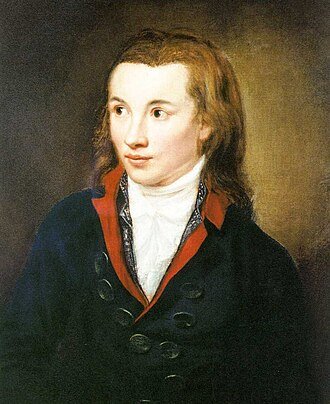
 AuthorNovalis1772–1801
Hymns to the Night is a cycle of poems by Novalis (Friedrich von Hardenberg), first published in 1800 in the final issue of the journal Athenäum. It was the only major work Novalis completed and published during his lifetime. Together with his Spiritual Songs, it is considered the peak of his poetry and one of the most important poetic works of early German Romanticism.
The poems arose in response to two losses. In 1795 Novalis met Sophie von Kühn, who was then twelve years old, and fell in love with her; the two were secretly engaged shortly afterwards, and her parents later gave their formal consent. Sophie's health declined because of a liver tumour, and she died in 1797, two days after her fifteenth birthday, while Novalis was away in Weißenfels, where he worked as an auditor for the saltworks. A few months later his brother Erasmo also died, which deeply affected the poet and made mourning the centre of his writing.
Two versions exist. The first, in manuscript, is in verse and is usually dated to late 1799 or early 1800. The second, which Novalis prepared for printing in early 1800 under the shortened title "The Night", is written mostly in rhythmic prose with some passages in verse. It is the version he himself approved, and scholars generally take it as the reference text.
The six hymns form three pairs. In each pair, the first hymn follows Novalis's characteristic three-stage pattern, moving from a happy life under the light, through a phase of painful estrangement, to liberation in the eternal night; the second recounts the awakening from that vision and the longing to return to it. Each pair marks a step up in experience and knowledge. The first hymn, for instance, praises light as a life-giving force but ends by reversing traditional values: the night, associated with loneliness and frustrated hopes, becomes a protecting mother and a sacred space of love, while light, the symbol of reason and enlightenment, is pushed aside.
The text blends autobiographical elements, such as Sophie's death, the engagement and the studies at the Freiberg Mining Academy, with a lyrical voice that should not simply be equated with the author. Its sources include mysticism and Pietism, Edward Young's Night Thoughts, Romeo and Juliet in August Wilhelm Schlegel's translation, Jean Paul's Invisible Lodge and Schiller's The Gods of Greece. Novalis takes from them motifs such as the maternal night or lovers united beyond death, but integrates them into what critics call an early Romantic mythology, a personal fusion of private myth and Christianity.
That mythology rests on the idea of an intermediary between the human and the divine: in Christianity this is Christ, and for Novalis it can also be the beloved who has died. Critics have pointed to the Italian Stil Novo and to Beatrice in Dante's Divine Comedy as possible precedents. For decades scholars have debated whether the hymns defend Christianity or rework the religious heritage in an unorthodox way, since some passages lament the replacement of European paganism by Christian faith. Later reception has treated them as one of the founding texts of the Romantic sensibility toward death and the nocturnal.
Themes
Other works by Novalis
Original Filopedia text based on Wikipedia (es) and Wikipedia (en) and Wikidata.