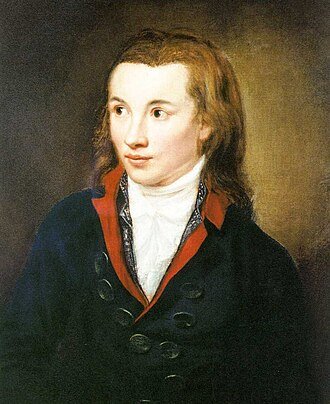
Novalis
1772–1801 · German poet and philosopher of Early Romanticism
Origins and family
Georg Philipp Friedrich von Hardenberg, known by the pen name Novalis, was born on 2 May 1772 at Wiederstedt, in the Electorate of Saxony, at the Schloss Oberwiederstedt, the family seat of a branch of the old Saxon nobility with roots in Lower Saxony. He was the second of eleven children of Heinrich Ulrich Erasmus von Hardenberg, a salt-mine administrator and a man of firm Pietist faith linked to the Moravian Brethren, and of his second wife, Auguste Bernhardine von Bölzig. The father's strict character caused some friction with his son, though it never became an irreparable conflict. The family lived in the castle without major upheavals until 1784, when the father was appointed director of the salt works at Dürrenberg, Kösen and Artern. The only serious disturbance of those early years was a dysentery outbreak around 1780 or 1781.
Early education
He was first taught by private tutors, in an atmosphere shaped by Pietism. In 1790 he attended the Luthergymnasium in Eisleben, where he acquired a solid grounding in rhetoric and classical culture. That humanist training left a lasting mark on his style.
University years and first verses
In October 1790 he enrolled at the University of Jena to study law, though his interests were already moving towards literature and philosophy. There he attended the lectures of Karl Leonhard Reinhold and of Friedrich Schiller. When Schiller fell ill in January 1791, Hardenberg helped to care for him together with other students. That same year he published his first text, the poem Lament of a Youth (Klagen eines Jünglings), in the journal Der neue Teutsche Merkur, under the initials "v. H*g." After a period of uncertainty about his future, during which he even considered becoming a soldier, he moved to Leipzig, and in 1792 he befriended Friedrich Schlegel, a friendship that lasted a lifetime. In 1793 he matriculated at the University of Wittenberg, where he took his law degree in 1794.
Tennstedt and the meeting with Sophie
In October 1794 he took a post as an official secretary in the district of Tennstedt, under August Cölestin Just, who became his close friend and, years later, the author of one of the earliest biographies of Novalis. In Grüningen he met Sophie von Kühn, aged twelve, and in March 1795, on her thirteenth birthday, they became secretly engaged. Hardenberg later said that a quarter of an hour had been enough for him to fall in love. In those months he wrote his philosophical notes on Fichte, the so-called Fichte Studies, in which he examined the limits of knowledge and the relations between the self and nature. In December 1795 he obtained a minor post in the administration of the salt mines at Weißenfels.
Sophie's illness and death
Sophie's health soon declined. She suffered a first crisis in November 1795, and during 1796 she underwent three operations without lasting improvement. Her family had been slow to accept the match. Sophie died in March 1797, at the age of fifteen, of tuberculosis. From then on Hardenberg kept a diary in which he dated his entries by the number of days since her death, and he devoted part of his reading to Goethe's Wilhelm Meister's Apprenticeship. His brother Erasmus died later that same year. Traditional criticism placed this relationship at the centre of his life and work, a view that later research has qualified, although the image of the poet marked by that loss has endured.
Freiberg and intellectual maturity
From late 1797 to mid-1799 he studied at the Mining Academy in Freiberg, where he attended geology lectures given by Abraham Gottlob Werner and pursued electricity, galvanism, chemistry, physics, medicine and natural philosophy. During this period he came into contact with Schelling, whose Naturphilosophie he had come to know, as well as with Goethe, August Schlegel and Jean Paul. It was an intensely productive time. In 1798 his fragments Pollen and Faith and Love appeared in the Schlegel brothers' journal Athenaeum, now under the name "Novalis". The name came from an old designation of his family, von Rode or de Novali, which referred to land newly brought under cultivation; the epigraph to Pollen evokes poor soil that must be sown generously. That year he also began his engagement to Julie von Charpentier, who stayed with him until the end.
Works, projects and final years
In 1799 he returned to Weißenfels as an assessor of the salt mines and, before long, a director. Around this time his friendship with Ludwig Tieck deepened, and Tieck would later play a decisive role in spreading his work. He wrote Christianity or Europe, an essay on Europe's spiritual unity that was not published during his lifetime, and worked on his novel Heinrich von Ofterdingen, conceived partly as a response to Goethe's Wilhelm Meister. The Hymns to the Night, inspired partly by his loss of Sophie, appeared in the Athenaeum in 1800. He also composed the devotional Spiritual Songs, which were later used in Lutheran worship. His project for an encyclopedia, the General Draft, gathered notes on all the sciences with the aim of uniting them in a common vision.
Illness and death
The lung problems that had accompanied him since childhood grew worse from August 1800, when he began coughing up blood. At the end of that year he was appointed to a post in the Thuringian district, but his health no longer allowed him to work. He died at Weißenfels on 25 March 1801, aged twenty-eight, in the presence of his friend Friedrich Schlegel and his brother Karl. Physicians and later biographers spoke of tuberculosis, though recent research has raised the possibility of cystic fibrosis. He was buried in the old cemetery at Weißenfels.
Reception and legacy
Only a few of his writings were published during his lifetime. After his death, Schlegel and Tieck issued a first collection in 1802 which, though valuable, contained alterations and rearrangements that encouraged an image of him as a dreamy mystic indifferent to reason. The blue flower, which appears in Heinrich von Ofterdingen, became an emblem of Romanticism. The critical historical edition begun by Paul Kluckhohn in 1929 and completed in the second half of the twentieth century allowed scholars to recover Novalis the philosopher and scientist, with a broad training in law, the natural sciences and philosophy. He is now studied as a thinker of the relation between the self and nature and as the creator of a "magical idealism" that sought to unite poetry, philosophy and science. His influence reached later thinkers and artists, from Lukács and Heidegger to the Surrealists.
Key ideas
- Identity as dialogue: the self is defined in relation to a you, not against an inert object.
- A critique of Fichte: for him, the tension between self and not-self is really a tension between language and imagination.
- The fragment as form: a way of joining poetry, philosophy and science in open, unfinished thoughts.
- Nature and knowledge: scientific inquiry and a poetic view of the world feed each other.
Where to start
Hymns to the Night 1800
Novalis's Hymns to the Night are a cycle of poems in rhythmic prose and verse, published in 1800, and the only major work the author completed and released during his lifetime. They are brief and intensely lyrical, and in them the reader will find the Romantic vision of night, death and love as a path toward the infinite.
Next: Heinrich von Ofterdingen. Heinrich von Ofterdingen, his unfinished novel, extends those lyrical intuitions into a narrative of formation that shows his poetic vision of the world in fictional form.
Works in Filopedia
Books to read
- Henry of Ofterdingen: A Romance. EnglishEPUB 206 KBRead online
Curiosities
A youthful poem dedicated to Schiller
His first published work was a poem dedicated to Schiller, whom he had helped nurse when the playwright fell ill in Jena.
A house that is now a museum
After his family moved to Weißenfels in 1784, the house they lived in became a museum, as did the castle where he was born.
Teachers and influences
Influenced
- Heinrich Heine 1797–1856
Original Filopedia text based on Wikipedia (es) and Wikipedia (en) and Wikidata.