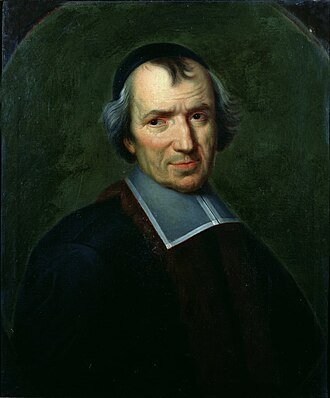
 AuthorAntoine Arnauld1612–1694
The Port-Royal Grammar, originally titled Grammaire générale et raisonnée, was published in 1660 by Antoine Arnauld and Claude Lancelot, two members of the Jansenist circle around the monastery of Port-Royal-des-Champs. It is the linguistic companion to the Port-Royal Logic (1662), and both works take their name from that monastery. Its aim is to explain, in a clear and natural way, the foundations of the art of speaking.
The book examines French with examples drawn from Latin, Greek, Arabic, Hebrew, Spanish, Italian and German, and its method is at once historical, comparative and philosophical. Among its influences are the speculative grammar of the Modistae, associated with Thomas of Erfurt, the grammars of humanists such as Scaliger, Sanctius, Ramus and Vaugelas, Andreas Helwig's etymology, Francis Bacon's project for a universal language, and the ideas of Descartes and Pascal.
Its central claim is that language reveals the structures of human thought, which rest on the logic of predication. For this reason all languages share common features: there is only one logic. Grammar, on this view, is not an arbitrary set of rules but an orderly expression of mental operations.
For nearly two centuries it served as a standard textbook for the study of language and went through many editions and translations. In the twentieth century it regained scholarly attention: Husserl considered it in his reflections on pure grammar, and Noam Chomsky invoked it in Cartesian Linguistics (1966) as a precursor of his idea of innate grammar. Historians such as Hans Aarsleff and Robin Lakoff later disputed that reading, arguing that the work does not posit an innate rational grammar but presents grammatical phenomena as devices invented to express mental experience.
Themes
Other works by Antoine Arnauld
- Port-Royal Logic 1662
Original Filopedia text based on Wikipedia (en) and Wikidata.