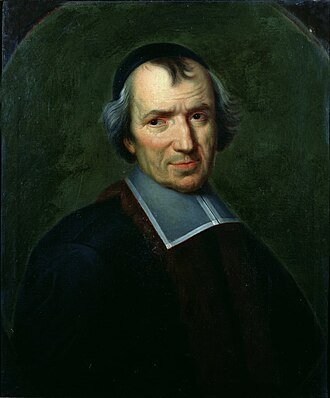
Antoine Arnauld
1612–1694 · French priest, theologian, philosopher and mathematician, Jansenist
Antoine Arnauld (Paris, 1612 – Brussels, 1694) was a French priest, theologian, philosopher and mathematician, and one of the leading intellectuals of the Jansenist circle at Port-Royal. His contemporaries called him le Grand to tell him apart from his father. Today he is remembered mainly for his work in logic and for his part in the religious controversies of the seventeenth century.
Born into a family of Parisian magistrates, he was the brother of the abbesses Angélique and Agnès Arnauld. He was first destined for the law, but he turned to theology at the Sorbonne, where he excelled. Under the influence of Jean Duvergier de Hauranne, the abbot of Saint-Cyran, he moved toward Jansenism. His book On Frequent Communion (1643) brought the movement's ideals to a wider public and made him many enemies. In 1655 his outspoken letters on the confessional practices of the Jesuits led to his expulsion from the Sorbonne, and Pascal wrote the Provincial Letters in his defence. Arnauld spent more than twenty years unable to appear openly in Paris, and he was formally degraded in 1656. A peace settlement brought him a measure of calm, but persecution resumed and he fled to the Netherlands before settling in Brussels, where he spent his final years in unending disputes with Jesuits, Calvinists and other opponents.
He embraced Descartes's philosophy early, with reservations about its orthodoxy, and between 1683 and 1685 he fought a long debate with Malebranche over the relationship between theology and metaphysics. With Pierre Nicole he wrote the Port-Royal Logic (1662), which served for generations as an elementary textbook. He also helped produce the Port-Royal Grammar and was regarded as a capable mathematician, though his standing in that field declined after his death. His lasting influence lies chiefly in the history of logic and grammar.
Key ideas
- Jansenist orthodoxy: he defended a strict reading of Augustine on grace and morality against the casuistry of the Jesuits.
- Moderate Cartesianism: he adopted Descartes's philosophy while doubting that parts of it were compatible with Christian orthodoxy.
- Logic as the art of thinking: with Nicole, he treated logic as a practical discipline for reasoning clearly, which was widely used in schools.
- Reasoned grammar: he held that the rules of language reflect the general structure of human thought.
Where to start
Port-Royal Logic 1662
The Port-Royal Logic, written with Pierre Nicole, is a clear and well-organized handbook on the art of thinking. Through everyday examples it explains how to form ideas, judge, and reason correctly, revealing Arnauld's concern for precision and evidence. It is an accessible entry point into his thought.
Next: Port-Royal Grammar. The General and Rational Grammar extends these ideas to language, showing how the structures of words reflect mental processes.
Works in Filopedia
- Port-Royal Grammar 1660
- Port-Royal Logic 1662
Curiosities
Reply to Nicole
When Nicole complained of being tired, Arnauld retorted: "Tired! when you have all eternity to rest in?"
Books too long
Arnauld remarked with some bitterness: "In spite of myself, it is very rare for my books to be very short."
Original Filopedia text based on Wikipedia (es) and Wikipedia (en) and Wikidata.