Ethics, Demonstrated in Geometrical Order
philosophical concept (central to Spinoza's main work, the Ethics)
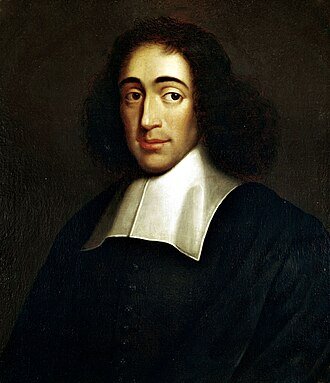 AuthorBenedictus de Spinoza1632–1677
Conatus (from the Latin conari, «to endeavor») is one of the most characteristic concepts in the philosophy of Baruch Spinoza. It designates an innate inclination of a thing to persevere in its being and to enhance itself. The thing in question may be a mind, a body, or a combination of both, and in Spinoza's pantheist view it is identified with God's power expressed in nature. Although the term has a long history, already appearing in antiquity among the Stoics and Peripatetics to describe the instinct of self-preservation in humans and animals, it acquired a technical meaning in the seventeenth century. René Descartes used it in a mechanistic sense, to explain the motion and rest of bodies and the tendency of objects to move away from or toward a center, while Thomas Hobbes defined it as the smallest initial impulse of motion, the origin of emotions and of the will. Spinoza took up these contributions and gave them his own formulation within a naturalistic framework in which humanity and nature are united under a single set of laws.
In the Ethics, Spinoza holds that «each thing, as far as it lies in itself, strives to persevere in its being». A thing cannot be destroyed except through the action of external causes, so conatus expresses the very essence of each individual. From this premise, Spinoza explains apparently irregular human behaviour as natural and rational: our desires, affects, and actions derive from conatus, which pushes us toward what increases our power of acting and away from what diminishes it. Desire is, in this sense, the awareness of one's own conatus. For Spinoza, an action is free to the extent that it proceeds from the individual's own essence and is not constrained by external forces; free will, by contrast, is an illusion born of ignorance of the causes that determine us.
The concept's influence has been considerable. Schopenhauer developed his notion of a «will to live» in parallel with conatus, though without limiting it in time, and Nietzsche rejected it in favor of the will to power. Later, classical physics replaced conatus with notions such as inertia and conservation of momentum, and in systems theory it has been related to the autopoiesis of living organisms. Today the term is used mainly in the history of philosophy.
Themes
Other works by Benedictus de Spinoza
Original Filopedia text based on Wikipedia (es) and Wikipedia (en) and Wikidata.