Ethics, Demonstrated in Geometrical Order
philosophical treatise in deductive form · 1677
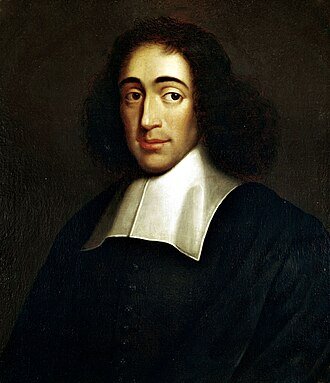 AuthorBenedictus de Spinoza1632–1677
The Ethics is a treatise written in Latin by the Dutch philosopher Baruch Spinoza between 1661 and 1675 and published posthumously in 1677 as part of his Opera posthuma. It is his best-known and most admired work, containing most of his philosophical thought. Spinoza intended to publish it during his lifetime, but in 1675 he withdrew the manuscript from the printing press under pressure from theologians and Cartesian philosophers who considered it atheistic. Even so, partial or complete copies had been circulating for years, and the Holy Office in Rome examined one. Within months of its edition, the Dutch government banned its circulation.
The book follows the method of Euclid's Elements: it starts from definitions and axioms and derives propositions, corollaries and scholia. Its aim is to build a coherent philosophical system that offers an objective picture of reality and explains what it means to live ethically. Its structure rests on the concept of substance. Against Descartes, who admitted several substances (thought, extension and God), Spinoza holds that there is only one infinite substance, which he identifies with God or Nature.
The first part, "Of God", argues that God is not outside the world and did not create it for a purpose or by an act of will; the universe follows necessarily from his nature. Things, human beings included, are modes of that single substance. The second part deals with the mind and the body, which are one and the same thing conceived in two ways, and with knowledge, distinguishing imagination, reason and an intuitive form that grasps things in their relation to God. The third and fourth parts examine the emotions and human bondage, which arises from being ruled by the passions. The fifth shows that reason can govern the emotions and lead to freedom and to a blessedness found in understanding things under the aspect of eternity.
It was scandalous in its own day and for decades was regarded as a forbidden book. Over time it became a landmark of rationalism, naturalism and modern thinking about freedom and the emotions, influencing the Enlightenment, German idealism and many later philosophers.
Themes
Books to read
- Ethics EnglishEPUB 228 KBRead online
Other works by Benedictus de Spinoza
Original Filopedia text based on Wikipedia (es) and Wikipedia (en) and Wikidata.