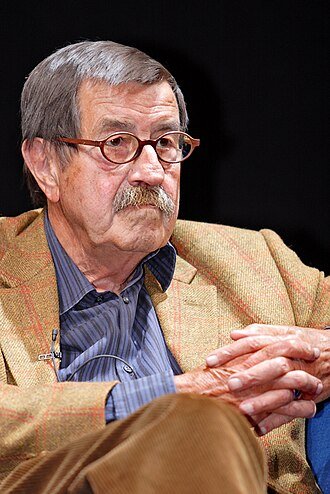
 AuthorGünter Grass1927–2015
Cat and Mouse is a novella by Günter Grass, published in 1961. It is the second part of the so-called Danzig Trilogy, of which The Tin Drum is also a part, and it continues much of the world of that earlier book. It is set in Danzig (now Gdańsk) around the time of the Second World War and Nazi rule.
The narrator, Pilenz, recalls Joachim Mahlke, a solitary boy without a father, from his youth until his disappearance near the end of the war. Much of the action takes place on a half-submerged sunken minesweeper of the Polish Navy, which the friends visit every summer. Mahlke explores the wreck by diving through a hatch and salvages items with his screwdriver, which he then sells or collects. Over time he steals a Knight's Cross from a visiting submarine captain and is expelled from school. He joins a tank division and, thanks to his battlefield successes, receives a Knight's Cross of his own; yet when he returns to his old school, the headmaster forbids him to give a speech to the students because of his earlier disgrace.
The narrative is deliberately disjointed: time is handled freely, and the narrator shifts between the second and third person when addressing Mahlke, suggesting his inability to separate his own feelings and sense of guilt from the account. The story lends itself to allegorical readings: the cat and the mouse stand for ordinary people, defenseless against brutal social forces, and Mahlke's prominent larynx works as a leitmotif. The novella was adapted for the cinema in 1966 by Hansjürgen Pohland, a version that caused controversy without achieving lasting renown.
Themes
Other works by Günter Grass
- The Tin Drum 1959
- Dog Years 1963
- The Rat 1985
- Crabwalk 2002
- What Must Be Said
Original Filopedia text based on Wikipedia (en) and Wikidata.