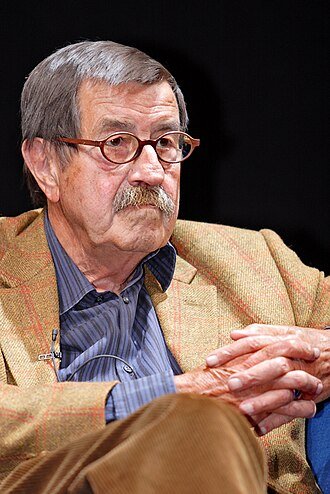
Günter Grass
1927–2015 · German novelist, poet and visual artist, Nobel Prize in Literature 1999
Childhood in Danzig
Günter Wilhelm Grass was born on 16 October 1927 in the Free City of Danzig, today Gdańsk in Poland. His father, Wilhelm Grass, was a Lutheran of German origin from Pomerania; his mother, Helene Knoff, was a Catholic of Kashubian and Polish descent. Grass himself identified as Kashubian and was raised a Catholic, serving as an altar boy as a child. His parents ran a grocery shop with a small attached flat in Danzig-Langfuhr, a working and lower-middle-class district whose everyday atmosphere would shape much of his imagination. He had a younger sister, Waltraud, born in 1930.
He attended the Conradinum gymnasium in Danzig. His adolescence coincided with the rise of Nazism and the war, and this experience became the seed of nearly all his later work.
Wartime service
In 1943, at sixteen, he was enlisted as an auxiliary in the Luftwaffe, the air force, and soon afterwards was conscripted into the Reich Labour Service. In November 1944, shortly after his seventeenth birthday, he volunteered for submarine service with the Kriegsmarine, by his own account to escape the stifling atmosphere of his parents' home. The navy turned him down, and in late 1944 he was called up to the 10th SS Panzer Division Frundsberg. He served with the unit from February 1945 and was wounded on 8 May. He was captured at Marienbad, today Mariánské Lázně in the Czech Republic, and held in an American prisoner-of-war camp at Bad Aibling in Bavaria, where he remained until 1946.
This episode provoked intense controversy. Many readers and critics faulted him for decades of silence, while others stressed that he had been enlisted while little more than a boy and that he had himself been a persistent critic of his country's Nazi past.
Training and early career as an artist
After the war he worked in a mine and trained as a stonemason. He then studied sculpture and graphic arts at the Düsseldorf Academy of Art, and during these years he drew, sculpted and began to write poetry. In 1953 he moved to West Berlin and continued his studies at the Berlin University of the Arts. He was also a co-founder of Group 47, gathered around Hans Werner Richter, a circle of young writers who read unpublished work and submitted it to the criticism of their peers, and which proved decisive in renewing German literature after the war.
The Danzig Trilogy
His best-known work, The Tin Drum, appeared in 1959. It tells the story of Oskar Matzerath, a boy who resolves to stop growing at the age of three and who observes from his distorted vantage point the rise of Nazism and the collapse of his family. The novel, together with Cat and Mouse (1961) and Dog Years (1963), forms the so-called Danzig Trilogy. All three use the author's native city and its ambiguous status between Germany and Poland as a symbol of mixed peoples and of the fragility of national identities. The style combines autobiographical realism with unreliable narrators, fantastic episodes and sharp satirical irony, traits that align him with magic realism. In West Germany of the late 1950s the book was controversial: the city of Bremen withdrew a prize it had awarded him over what its leaders judged the novel's immorality. Volker Schlöndorff's 1979 film adaptation won the Palme d'Or at Cannes and the Academy Award for Best Foreign Language Film.
Political commitment
For several decades Grass was an active supporter of the Social Democratic Party. He backed Willy Brandt's campaigns and argued for gradual democratic reform over left-wing radicalism, an idea that gave the title to his campaign diary, From the Diary of a Snail. He opposed the building of the Berlin Wall in 1961 and sharply criticised the repression of workers in East Germany. After the fall of the wall he opposed a hasty reunification, and in 1990 published essays such as Writing after Auschwitz and Germany: An Unwise Unification. In 2012 a poem about Iran's nuclear programme and Israel's role caused another controversy, and led Israel to declare him persona non grata.
Later works and last years
His mature output includes The Flounder (1977), a novel about relations between the sexes that attracted feminist criticism, The Meeting at Telgte (1979), about the German writers of the Baroque, and The Rat (1986). With My Century (1999), a year-by-year tour of the twentieth century, and Crabwalk (2002), which recounts the sinking of the refugee ship Wilhelm Gustloff with thousands aboard, he returned to the centre of literary debate. His memoirs, Peeling the Onion (2006), revealed his Waffen-SS service and his long silence about it, and were followed by The Box (2008) and Grimms Words (2010). In 2014 he announced that he would write no more novels, though he continued to publish poetry and drawings. A tireless draughtsman and sculptor, he also illustrated Andersen's tales in The Shadow, for which he received the Hans Christian Andersen Award for illustration in 2005.
Nobel Prize and honours
In 1999 the Swedish Academy awarded him the Nobel Prize in Literature, praising him as a writer "whose frolicsome black fables portray the forgotten face of history". He had previously received the Georg Büchner Prize in 1965 and later the Hermann Kesten Prize; in 1992 he was given the Hidalgo Prize by the Spanish association Presencia Gitana for his defence of the Romani people, and in 2012 he received the European of the Year award from the European Movement Denmark. His work belongs to the German movement of Vergangenheitsbewältigung, the effort of German culture to come to terms with its past.
Legacy and death
Grass died on 13 April 2015 in a hospital in Lübeck, at the age of 87, of a lung infection. For much of his adult life he was an inveterate pipe smoker. His influence can be traced in writers such as John Irving and Salman Rushdie. He was buried privately at Behlendorf, near Lübeck, where he had lived since 1995, and the main eulogy at his memorial service in the Lübeck theatre was delivered by John Irving.
Key works
- The Tin Drum (1959): the first novel of the Danzig Trilogy, narrated by a boy who decides to stop growing.
- Cat and Mouse (1961): the second part of the trilogy, a short novel about guilt and the memory of youth.
- Dog Years (1963): closes the trilogy with a satirical look at Nazi Germany and the postwar period.
- The Flounder (1977): a reworking of a folktale that examines power and relations between the sexes.
- Crabwalk (2002): a novel about the sinking of a refugee ship carrying Germans and about the memory of the war.
Where to start
The Tin Drum 1959
The Tin Drum is the best entry point to Grass. Narrated by Oskar Matzerath, a boy who decides not to grow up, it traces twentieth-century German history from Danzig with humor, brutality and boundless imagination. It is accessible, representative of the author's universe, and the work that brought him international fame.
Next: Cat and Mouse. Cat and Mouse continues the Danzig Trilogy with a shorter, more concentrated narrative, ideal for exploring the same world and characters further.
Works in Filopedia
- The Tin Drum 1959
- Cat and Mouse 1961
- Dog Years 1963
- The Rat 1985
- Crabwalk 2002
- What Must Be Said
Curiosities
A maternal pen name
In 1968 he published a collection of short stories, *Geschichten*, in Berlin under the pseudonym «Artur Knoff», taking his mother's surname.
A withdrawn prize
The city of Bremen revoked a prize it had awarded him, citing what its leaders considered the immorality of his first novel.
Teachers and influences
Influenced
- Philip Roth 1933–2018
Original Filopedia text based on Wikipedia (es) and Wikipedia (en) and Wikidata.