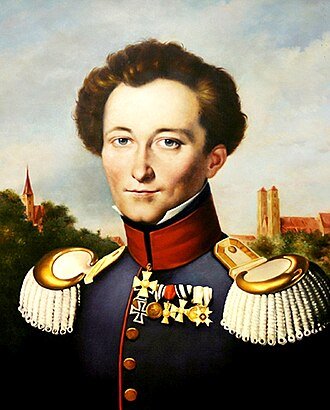
 AuthorCarl von Clausewitz1780–1831
On War (Vom Kriege, in German) is a treatise on military theory by the Prussian officer Carl von Clausewitz (1780–1831). Most of it was written between 1816 and 1830, after the Napoleonic Wars, which had changed the nature of warfare by mobilizing entire populations and state resources on a scale Europe had not seen before. Clausewitz had fought against Napoleon for much of his life, and that experience, combined with his education in history, art and science, provided the basis for his reflections.
The work was left unfinished. In 1827 Clausewitz set out to revise his manuscripts but died before completing the task. His wife, Marie von Brühl, edited and published the papers between 1832 and 1835. The book is made up of eight parts, the last two of which exist only in draft form. Its central idea is that war is not an end in itself but an instrument of politics: "war is merely the continuation of policy by other means." From this follows the distinction between political purposes, military goals and the means used to reach them, and the view that war takes its character from the circumstances of each conflict rather than from universal rules.
The book also introduced concepts that became standard in military analysis: the "fascinating trinity" of war (the people, the army and the government), the "fog of war", the "friction" that undoes even the most detailed plans, the asymmetric relationship between attack and defense, and the "culminating point" of the offensive. Clausewitz argued that strategy is a field of decisions taken with incomplete information and under time pressure, and that uncertainty grows the further one moves from strategy toward the tactical level.
Its reception has been wide and contested. It was studied closely in European military academies and, over time, around the world. Critics such as Antoine-Henri Jomini, B. H. Liddell Hart, Martin van Creveld and John Keegan have faulted it for its focus on the nation-state and on wars between regular armies, leaving aside earlier conflicts and insurgencies. Even so, it remains one of the most cited texts on the relationship between war, politics and society.
Themes
Books to read
- On War EnglishGutenberg
Original Filopedia text based on Wikipedia (es) and Wikipedia (en) and Wikidata.