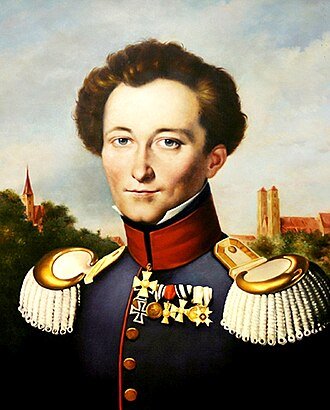
Carl von Clausewitz
1780–1831 · Prussian army officer and military theorist
Origins and early training
Carl Philipp Gottlieb von Clausewitz was born on 1 July 1780 in Burg, near Magdeburg, in the Duchy of Magdeburg, then part of the Kingdom of Prussia. He was the fourth and youngest son of a middle-class family of modest means that claimed noble descent. His paternal grandfather had been a professor of theology, and his father had served as a lieutenant in the army of Frederick the Great until, after the Seven Years' War, he was dismissed for not being of noble birth. Clausewitz and two of his brothers were the first in the family to use the "von" particle, and historians still debate whether the title was a reward for service or the recognition of an older origin.
The first years in the army
In the summer of 1792, at the age of twelve, he enlisted as a lance corporal in the 34th Prussian infantry regiment; his family brought his birth date forward so that he would appear to be thirteen. He saw his first action in the Rhine campaigns of 1793 and 1794, including the siege of Mainz, during the Prussian invasion of France in the years of the Revolution. After Prussia withdrew from the war in 1795, he spent five years on garrison duty at Neuruppin.
Self-education and the Kriegsakademie
He used that garrison period to educate himself, and his interests reached well beyond the purely military: art, science, education, philosophy and ethics. This self-directed training earned him a place at the newly founded Kriegsakademie in Berlin in 1801, at the age of twenty-one. There he studied Kant in depth, whose influence can be traced in his later work, and won the favour of General Gerhard von Scharnhorst, the Academy's director and future first chief of staff of the reformed army. He graduated first in his class in 1804 and was appointed aide-de-camp to Prince August Ferdinand. The following year he published his first writing, an article in the journal Neue Bellona criticising ideas on strategy put forward by Heinrich von Bülow.
The defeat of 1806 and captivity
When Napoleon invaded Prussia in October 1806, Clausewitz was serving as an aide in the Prussian-Saxon army under the Duke of Brunswick. At the battle of Jena, on 14 October, the Prussian army was shattered. Clausewitz, then twenty-six, was one of some 25,000 prisoners taken that day, and he remained a captive in France until 1808. The defeat was a shock to him and to many of Prussia's ablest officers, who saw a monarchy crushed by an army of popular and revolutionary origin. On his return he joined the reform movement led by Scharnhorst and August Neidhardt von Gneisenau, with whom he formed a lasting friendship. He taught at the Academy and in 1810 married Countess Marie von Brühl, a cultivated and well-connected woman who played an important part in his career and later edited his posthumous works. That same year he became military tutor to the crown prince, Frederick William, for whom he wrote the Principles of War, an early and rudimentary text that anticipated, in outline, his later ideas.
Russia, the alliance against Napoleon and Waterloo
In 1812, opposed to Prussia's alliance with Napoleon, Clausewitz left the Prussian army and served in the Russian army during the invasion of Russia. He took part in the battle of Borodino and witnessed the French retreat. He helped negotiate the Convention of Tauroggen, which opened the way to the coalition against Bonaparte. In 1813, when the Russian-German Legion was reintegrated into the Prussian army, his standing at court had suffered from his defection, and he obtained no command of troops until Gneisenau took him on as aide. He fought at Leipzig and at Lützen, where he was wounded after personally leading several cavalry charges. In 1815 he served as chief of staff of Thielmann's III Corps during the Waterloo campaign. His unit fought at Ligny and, above all, at Wavre, where it held out against greatly superior numbers and prevented French reinforcements from reaching Waterloo.
Director of the Academy and the years of retirement
In 1818 he was promoted to major general and appointed director of the Prussian Military Academy in Berlin. The court still regarded him with suspicion, and Restoration Prussia was turning towards a conservatism hostile to the reforms he had helped to shape. He held the post until 1830, in what amounted to a gilded retreat. As director he could not teach or apply his pedagogical ideas directly, so he devoted his time to essays on military campaigns and above all to the work that would become his principal book, On War, on which he had been working since 1816 without finishing it.
Death and the publication of On War
In 1830, as revolutionary movements spread across Europe and a crisis erupted in Poland, he returned to active duty as chief of staff of the only army Prussia could mobilise, serving under his friend Gneisenau. A cholera epidemic struck the troops, and Gneisenau died of the disease in August 1831. Clausewitz, after returning to Breslau, caught the same illness and died on 16 November 1831, aged fifty-one. In 1832 his widow published the unfinished manuscripts under the title On War. The book runs to eight volumes and contains material written at different stages of his intellectual development, a fact that has given rise to much debate over apparent contradictions.
Central ideas and their interpretation
His most quoted remark, that war is the continuation of policy by other means, makes most sense within the whole of his argument. For him war is a "trinity" of original violence and hatred, the play of chance and probability, and the subordination of rational purpose to a political aim. He understood strategy as the use of engagements to achieve the object of war, and held that war has a social and political nature, not merely a military one. His dialectical method, which advances through thesis and antithesis, lent itself to misreading: the Prussian and later German General Staff took some of his ideas as support for total war, a term he himself never used. His influence extended to Marx, Engels, Lenin and Mao, and to the Soviet and Chinese military traditions, and concepts such as the fog of war and the centre of gravity derive from his work.
Key ideas
- War as politics: war is the continuation of policy by other means and cannot be separated from its political aims.
- The fog of war: incomplete information, doubt and fear force commanders to decide quickly under uncertainty.
- The moral and psychological side: war is fought in the minds of combatants and of those who direct it, not only on the ground.
- Against geometry: military theory cannot be reduced to maps, formulas and graphs.
- The value of history: historical experience must test learned abstractions.
Quotes
“War is the continuation of policy with other means.”
De la guerra
Works in Filopedia
- On War 1832
Books to read
- Grundgedanken über Krieg und Kriegführung GermanEPUB 130 KBRead online
- On War EnglishGutenberg
Curiosities
A corporal at twelve
He enlisted in the Prussian army at twelve as a lance corporal. His family changed his birth date to make him look older.
A book published after his death
He began work on On War in 1816 but never finished it. His wife prepared it for publication in 1832, after his death.
Teachers and influences
Influenced
- Robert Greene b. 1959
Original Filopedia text based on Wikipedia (es) and Wikipedia (en) and Wikidata.