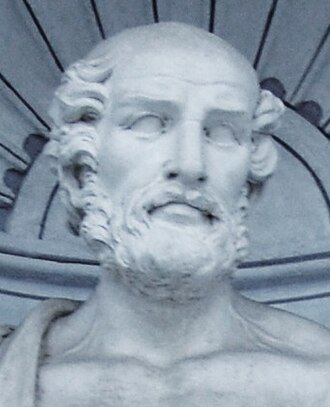
 AuthorTheophrastus370 BC–286 BC
The History of Plants (Greek: Περὶ φυτικῶν ἱστοριῶν, traditionally known in Latin as De historia plantarum) is one of the foundational works of Theophrastus of Eresos (c. 371–287 BC), the pupil and successor of Aristotle at the Lyceum. It was written in the second half of the 4th century BC, probably between about 350 and 287 BC, and survives in nine of its original ten books. Together with Aristotle's History of Animals, it stands as one of the earliest major works of natural history from antiquity, and its significance for botany was such that Linnaeus called Theophrastus the "father of botany".
The text was not designed as a continuous piece for reading. Its condensed style and many lists of examples suggest working notes used in teaching, which Theophrastus kept revising until his death without giving them a final form. He describes plants by their structure, reproduction and growth, their geographical distribution, the timber they yield, and their practical uses, especially as food and medicine. His main novelty was to attempt a classification based on how plants reproduce, an approach without precedent in the history of botany, though the divisions he proposes are, as he himself admits, rough and approximate.
The overall plan is arranged in thematic blocks. Book 1 covers plant anatomy, including leaves, flowers, fruits, seeds, roots and wood, and draws a basic distinction between trees, shrubs, perennial herbs and annual plants. Book 2 deals with propagation, whether spontaneous, from seed or from vegetative parts. Books 3 to 5 discuss wild trees, trees and shrubs from other regions, and timber, with observations on their use in carpentry, shipbuilding and charcoal production. Book 6 describes shrubs and thorny plants, Book 7 herbaceous plants, and Book 8 cereals. Book 9, the most influential in later tradition, deals with the juices, gums and resins used in medicine and explains how to gather them.
The work draws on varied sources, among them drug-sellers and root-cutters, and mentions some five hundred species. After its composition it remained within the Peripatetic school and was a constant reference throughout the Middle Ages. It was translated into Latin in the fifteenth century, printed in Greek between 1495 and 1498, and during the Renaissance it took its place alongside Pliny's Natural History and Dioscorides' De materia medica as a central text of natural history.
Themes
Other works by Theophrastus
Original Filopedia text based on Wikipedia (es) and Wikipedia (en) and Wikidata.