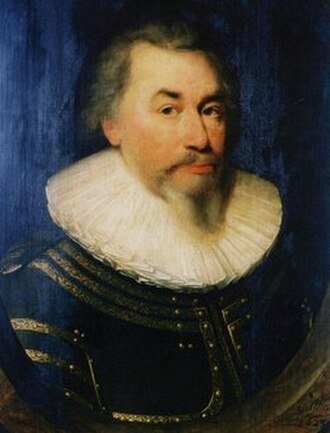
Robert Filmer
1588–1653 · English landowner and political writer who defended the divine right of kings
Sir Robert Filmer was an English landowner, justice of the peace and political writer, best known for defending the divine right of kings. He lived in the decades when the struggle between the Crown and Parliament grew sharper, and his name survives mainly because of the rebuttals his ideas provoked.
He was born around 1588 at East Sutton in Kent, the eldest child of a family with deep roots in the county. He matriculated at Trinity College, Cambridge, in 1604 without taking a degree, and was admitted to Lincoln's Inn in 1605. He was called to the bar in 1613, though there is no evidence that he practised law. In 1618 he married Anne Heton, and King James I knighted him. After his father's death in 1629 he inherited the family manor and estate, and in the 1630s he served as a justice of the peace and an officer of the county militia. His life was largely local and domestic, far from the court.
During the conflict with the Long Parliament he opposed its actions. His manor house was looted in 1642, and his properties were heavily taxed the following year. He was imprisoned for several years at Leeds Castle, and he died around 26 May 1653.
His writings were informal and unsystematic, and he did not seek publication. His most famous work, Patriarcha, or the Natural Power of Kings, circulated in manuscript and appeared posthumously in 1680. In it he argues that a father's rule over his household is the model for all government, that the authority given to Adam passed to the patriarchs and then to kings, and that a monarch cannot be judged by his subjects.
His influence came largely through the opposition he provoked. John Locke devoted the first of his Two Treatises of Government to refuting him, and Algernon Sidney and James Tyrrell also wrote against his views. Decades later, during the reign of Queen Anne, his doctrines enjoyed a brief revival.
Key ideas
- The father as model of power: a father's rule over his family is presented as the natural origin of all political authority.
- Inheritance of Adam's power: the authority God gave Adam supposedly passed to the patriarchs and from them to kings.
- Absolute monarchy: the king is bound neither by his predecessors' acts nor by his own, since no one can give a law to himself.
- Rejection of democracy: the people cannot judge or depose their king, because they would become judges in their own cause.
Works in Filopedia
Curiosities
A work published after his death
Patriarcha appeared in 1680, about twenty-seven years after Filmer's death, on the eve of the Glorious Revolution.
The 'great champion of absolute power'
John Locke gave Filmer this title when he devoted the first of his Two Treatises to refuting him.
Imprisoned on a false charge
A tenant claimed Filmer had hidden weapons for the Royalists, but the charge was apparently false. He was still held for several years at Leeds Castle.
Teachers and influences
Influenced
- John Locke 1632–1704
Original Filopedia text based on Wikipedia (es) and Wikipedia (en) and Wikidata.