Plutarch
40–120 · Greek philosopher, historian and biographer
Origins and family
Plutarch was born in Chaeronea, a small town in Boeotia, around AD 46 or 50, during the reign of the emperor Claudius. Chaeronea kept the memory of its glorious role in Greek history, but in his time it was a modest place. He belonged to a well-off family long established in the region. His father was named Autobulus and his grandfather Lamprias, a learned man who appears as a speaker in the Table Talk. He had at least two brothers, Timon and Lamprias, the latter a priest at Lebadea. His writings show an affectionate bond with his family, especially with Timon.
Education in Athens
Thanks to his family's means he studied philosophy, rhetoric and mathematics in Athens around AD 67. His main teacher was Ammonius, who taught at the Academy and steered him towards mathematics, although Plutarch was more drawn to ethics. A lost title, Ammonius, or On the Involuntary Coexistence with Evil, suggests this early moral interest. He is usually counted a Platonist, though he engaged constantly with the Aristotelians in his works.
Travels and early public office
After his studies he returned to Chaeronea, but his town sent him to deal with administrative matters before the Roman proconsul at Corinth. Around AD 67 he set off on a study tour that took him to Alexandria and Asia Minor, where he probably visited Smyrna, then an important centre of the so-called Second Sophistic. He may have taken part in the Eleusinian Mysteries. Back home he served as a magistrate in Chaeronea and represented his town on missions abroad. He held the archonship in his native town, an annual office he probably held more than once.
His friend Lucius Mestrius Florus, a Roman consul, helped him obtain Roman citizenship, and Plutarch then adopted the name Lucius Mestrius Plutarchus. According to the chronicler George Syncellus, Trajan later appointed him, late in life, nominal procurator of Achaea, which entitled him to wear the vestments of a consul. He visited Rome at least three times, once shortly before the death of Vespasian, once around AD 88 and once under Domitian, and there he mixed with senators and the educated elite. Among them were Quintus Sosius Senecio, twice consul, who also hosted him in Greece and to whom he dedicated several works, and Gaius Julius Antiochus Epiphanes Philopappus.
Priesthood at Delphi
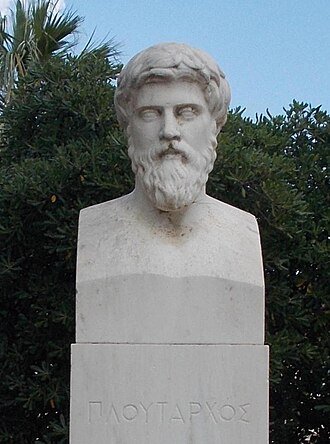
Around AD 95 Plutarch was made one of the two priests of Apollo's temple at Delphi, a sanctuary that had lost much of its former glory. His duties included interpreting the responses of the Pythia, though they took up only a modest part of his time. In the 90s, with the support of Greek patrons and possibly of imperial authority, Delphi enjoyed a notable building revival. A portrait bust once associated with Plutarch, for his work in reviving the shrines, survives in the local archaeological museum, though its identification is not fully certain. On the oracle he wrote On the E at Delphi, On the Oracles of the Pythia and On the Obsolescence of Oracles.
His family life centred on Chaeronea. With his wife, Timoxena, he had several children, most of whom died young. The death of a little daughter, also named Timoxena, inspired his Consolation to His Wife. His sons Autobulus and Plutarch are addressees of some of his writings, including the treatise on Plato's Timaeus.
Language and scope of his work
Plutarch moved with ease in Greek, the language of learned culture even in Rome, where the elite was bilingual. He learned Latin properly only in later life, when he needed it for his historical work. His command was limited: he cites few Latin works and sometimes misreads them. Among Latin poets he mentions mainly Horace, and he seems to have ignored Virgil and Ovid altogether.
The so-called Catalogue of Lamprias, probably compiled by one of his sons, lists 227 titles, of which about half survive. His output falls into two great groups: the Parallel Lives and the Moralia, a collection of essays on very varied subjects.
The Parallel Lives
His best-known work is the Parallel Lives, biographies of famous Greeks and Romans arranged in pairs so as to compare their virtues and vices. Plutarch did not aim to write history in the strict sense but to explore how character, good or bad, shapes a man's life and fate. He says so at the opening of the Life of Alexander: what matters is not so much the great battles as a saying, an anecdote or a gesture that reveals a person's nature.
Twenty-three pairs survive, together with four unpaired lives. Among the most famous are those of Alexander, Caesar, Pericles, Cicero, Cato, Antony, Brutus, Coriolanus and Theseus. His Alexander is a valuable source, with anecdotes found nowhere else. Plutarch was not a rigorous historian: he quotes from memory, takes over second-hand information and sometimes errs, yet he knew how to separate the plausible from the legendary, as he warns at the start of the Life of Theseus. Some important lives are lost, including those of Heracles and Philip II of Macedon.
The Moralia and his thought
The Moralia gather some seventy-eight pieces on diverse topics, brought together under this title by the Byzantine monk Maximus Planudes in the fourteenth century. They include treatises on ethics, politics, philosophy, theology, zoology, education and literary criticism, as well as lighter dialogues such as Odysseus and Gryllus. Notable are On Isis and Osiris, a key source on Egyptian religion and perhaps his last work, and the Table Talk, in nine books, one of his longest works.
In philosophy he was a Platonist open to Peripatetic and, in some points, Stoic influence, but he rejected Epicureanism firmly. He gave little weight to theoretical questions and was chiefly concerned with morality and religion. He defended a pure idea of God against Stoic materialism and Epicurean atheism, upheld freedom of the will and the immortality of the soul, and assigned a role to daemons as intermediaries. His ethics is closely tied to religion, and his ideal is a virtuous life governed by moderation and reason.
The Moralia also contain pseudepigrapha, works attributed to an anonymous author called pseudo-Plutarch, such as the Lives of the Ten Orators and On Music, probably written between the third and fourth centuries.
Reception and legacy
Plutarch was read with great interest in late antiquity and the Renaissance. Jacques Amyot's French translation of the Lives, published in 1559, had a decisive influence across Europe. Montaigne, who read it with admiration, used it as a model for his Essays, and Shakespeare drew on Thomas North's English version for several plays. Rousseau knew the Lives from childhood and admired his account of Sparta. During the French Revolution his heroes inspired tragedies, and Napoleon counted him among his favourite reading. In Spain he was translated from the fourteenth century on, and Quevedo wrote a glossed version of the Life of Brutus. Emerson called the Lives "a bible for heroes".
Today he is recognised as one of the great Greek prose writers, a narrator who combined learning and curiosity without pedantry, and as an indispensable witness to Greek and Roman culture in the early empire.
Key ideas
- Parallel Lives: biographies of Greeks and Romans paired so that their shared moral virtues and vices can be compared.
- Character as the key: personal traits, more than great deeds, explain people's choices and destinies.
- Practical morality: virtue is built through habit, and philosophy should guide everyday conduct and public life.
- Reasoned piety: he rejected both scepticism and superstition and defended a moderate, rational faith.
Works in Filopedia
- Parallel Lives 110
Books to read
- Plutarch: Lives of the noble Grecians and Romans EnglishEPUB 1,7 MBRead online
- Plutarch's Morals EnglishEPUB 525 KBRead online
- Plutarch's Lives, Volume 3 (of 4) EnglishEPUB 647 KBRead online
- Plutarch's Lives, Volume 1 (of 4) EnglishEPUB 487 KBRead online
- Plutarch's Lives, Volume 4 (of 4) EnglishEPUB 741 KBRead online
- Plutarch's Lives, Volume 2 (of 4) EnglishEPUB 551 KBRead online
- Selected Essays of Plutarch, Vol. II. EnglishEPUB 454 KBRead online
- Complete Works of Plutarch — Volume 3: Essays and Miscellanies EnglishEPUB 740 KBRead online
- Plutarch's essays and miscellanies, Vol. 1 (of 5) : Comprising all his works collected under the title of "Morals" EnglishEPUB 698 KBRead online
- Plutarch's essays and miscellanies, Vol. 5 (of 5) : Comprising all his works collected under the title of "Morals" EnglishEPUB 618 KBRead online
- Between Heathenism and Christianity Being a translation of Seneca's De Providentia, and Plutarch's De sera numinis vindicta, together with notes, additional extracts from these writers and two essays on Graeco-Roman life in the first century after Christ. EnglishEPUB 218 KBRead online
- Plutarch's essays and miscellanies, Vol. 2 (of 5) : Comprising all his works collected under the title of "Morals" EnglishEPUB 578 KBRead online
- Plutarch's essays and miscellanies, Vol. 3 (of 5) : Comprising all his works collected under the title of "Morals" EnglishEPUB 802 KBRead online
- Selected Essays of Plutarch, Vol. I. EnglishGutenberg
Curiosities
A rising dream
According to Artemidorus, in his Oneirocritica, shortly before his death Plutarch dreamed that Hermes led him up to heaven.
A fictional descendant
Apuleius, author of The Golden Ass, made his fictional protagonist a descendant of Plutarch.
Late Latin
Plutarch learned Latin well into adulthood, when he needed Latin sources for his historical works.
Teachers and influences
Influenced
- William Shakespeare 1564–1616
Original Filopedia text based on Wikipedia (es) and Wikipedia (en) and Wikidata.