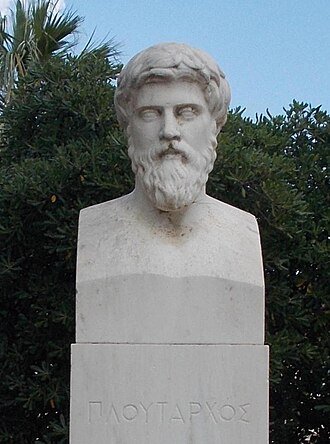
 AuthorPlutarch40–120
The Parallel Lives is a series of biographies of famous Greeks and Romans written in Greek by Plutarch, probably around the turn of the first and second centuries CE. Plutarch paired the lives, each couple made up of a Greek and a Roman whose careers he judged similar, such as Alexander and Caesar or Demosthenes and Cicero. At the end of many pairs he added a short comparison, the synkrisis, which pointed out what set each man apart and placed them on an equal footing. Twenty-three pairs survive, to which four single lives are added: Artaxerxes, Aratus, Galba and Otho. Other biographies are known to have existed but are now lost.
Plutarch's aim was less to narrate political or military events than to explore the moral character of each figure. For this reason he dwells on upbringing and natural dispositions and gives a great many anecdotes, which in his view reveal more about a man than a won battle. This orientation means the work is best read as biographical literature rather than strict history. Plutarch was well aware of how hard it is to recover the truth of the past, since his sources were uncertain and writers could distort events out of malice or flattery, and his treatment of some figures departs from the historical accounts he used.
The work also reflects his conviction that Rome should rule and Greece educate, and it contains many memorable historical passages. It was widely read in the Renaissance, when humanists sought models of virtue in classical antiquity. In Spain it inspired chroniclers and prose writers of the fifteenth and sixteenth centuries; in France Montaigne quoted it often, and Rousseau counted it among his favourite books. Shakespeare drew on it for Julius Caesar, Coriolanus and Antony and Cleopatra, largely through Thomas North's English version, itself based on Amyot's French translation.
Themes
Original Filopedia text based on Wikipedia (es) and Wikipedia (en) and Wikidata.